Merci, Armand

Once a snob about reading mysteries, I sneered at them as a colossal waste of time. Now I know how much I can learn from them, how happily I can grow absorbed in their worlds. Last week introduced the Canadian writer Louise Penny and her intriguing mystery series featuring detective Armand Gamache. This week focuses on one of the books, A Great Reckoning. It’s better to start with Still Life, the first, but Penny weaves in enough background so the reader starting in the middle won’t feel totally lost.

Two elements of A Great Reckoning seem particularly noteworthy. One is a creative, artistic map woven throughout as a symbol, but no one knows its significance until the end. It’s touching when Gamache and his group discover it was left by a grieving mother for her three sons, missing in action during World War I, just in case they needed to find their way home.  Though all had died, it prompted me to think about the many teachers who’ve offered maps to uncharted inner territory: most recently, Henri Nouwen, Kathleen Singh, James Finley. Their books have been signposts, maps of a different kind, offering pathways Home.

In a moving scene near the end, after the murders have been solved and Armand returns to his deepest joy, his family, the local community and officers who’ve been key to the action gather in the village church for the baptism of the Gamaches’ grandson. The minister asks, “Who here stands for this child?” Two previously designated godparents stand, then the most cantankerous, foul-mouthed, nasty alcoholic stands, straight, tall and resolute. Gradually, one by one, the whole congregation follows her lead and stands. Even a pet duck rises, looking “as dignified as a duck possibly could.”

I don’t know if that question is particular to the Canadian rite, but how it resonates. In the face of the all-too-prevalent wreckage to children—in war, parental abuse, separation of families at the border, blatant neglect, dismal schools–the whole sickening list—someone must stand. Who will be voice for the voiceless, shield for the vulnerable, advocate in a system that steamrolls the innocent? In a small response that barely registers on the cosmic scale, the question prompted the renewal of my commitment to volunteer in an Oakland first grade for another year.

The Gift of a Guilty Pleasure

In March, I spent five days in surprisingly uncomfortable living conditions. No way to change; simply adapt. What helped? Knowing that every night for an hour of reading, I could slip into the comforting world of Armand Gamache. He’s the detective hero of Louise Penny’s mystery series. I hesitate to use the word hero, because he’s the first to admit being “a crowd of faults.” His mistakes are public knowledge, and he directs the officers he educates to four signposts: saying, “I’m sorry. I was wrong. I don’t know. I need help.” Hardly the unflappable, infallible superhero we might first associate with the term.

But how could books which inevitably depict at least one gory murder bring such consolation? Since the August readings in some traditions are full of bread references, maybe it’s not a leap to the Quebec variety: croissants and baguettes. Armand Gamache, his wife, colleagues and friends eat often and well. Cookies, bowls of café au lait, eclairs, hot chocolate, soups, and wine abound—how else does one survive a Canadian winter? Furthermore, Penny sets her stories in a fictional community where anyone would long to live: Three Pines, a charming place surrounded by deep forests, rivers and mountains.  

She writes of it: “The village does not exist physically… Three Pines is a state of mind. When we choose tolerance over hate. Kindness over cruelty. Goodness over bullying. When we choose to be hopeful, not cynical. Then we live in Three Pines.“ At its heart is a bistro with fireplaces, high ceiling beams, cozy chairs and food that leaves the reader drooling. Penny says of the choices above, “I don’t always make those choices, but I do know when I’m in the wilderness and when I’m in the bistro.” It’s led me to wonder if we can’t all create a Three Pines of the heart—maybe easier for those who as children lived imaginatively in Narnia or the Secret Garden or Hogwarts.

All the books in the series are intriguing, full of wit, literary references, unpredictable characters and twisty plots. At the center of each stands Armand—a scarred, honest, calm, strong, kind, unorthodox, wounded, brilliant leader. Simply by listening carefully, he can get a surprisingly accurate read on every suspect in a crime. While it would be ease and joy to devote a blog to every book, the focus next week will be on A Great Reckoning.  

Once a reading snob, I’m grateful now to dive into the wicked, wonderful world of mysteries. May go back to earliest days reading Nancy Drew…

For those asking about the trees retreat described last week, it was given by arborists Dennis and Anne Yniguez at San Damiano Franciscan Retreat Center, Danville CA, https://sandamiano.org.

The Company of Trees

“Trees are poems the earth writes on the sky.”–Kahlil Gibran

I am a retreat junkie, but a recent “retreat under the trees” was a unique experience, different from any ever made before. For a whole weekend, two arborists simply taught about trees. Over and over, we saw the remarkable design and care poured into every leaf. How bent on light and life the tree is, how it works against gravity to soar, how it gains ground by going nowhere. The tree is like an interdisciplinary classroom, combining chemistry, engineering, art, geometry and poetry.  I will never see a green, leafy canopy the same way again, now recognizing in it “so great a cloud of witnesses.” (Hebrews 12:1)

Recent research has confirmed the deft strategies a tree uses to survive drought, fire, wind, floods, animals like deer nibbling on its bark. While my understanding is rudimentary and far from complete, I highly recommend The Hidden Life of Trees by Peter Wohlleben and Finding the Mother Tree by Suzanne Simard  to expand this brief description. Video versions and adaptations for children are also available. The more one learns, the more one agrees with American philosopher Ralph Waldo Emerson: “The wonder is that we can see these trees and not wonder more.” 

Redwoods, the tallest trees in the world, some almost 300 feet high, send out roots as long as 6 feet, graft roots onto each other for stability, and grow in groves to protect from wind. After an old one falls, a fairy ring of tubers sprouts, new clones of the original parent. These saplings then grow in a family circle, nourishing and protecting each other from pests and other threats through a silky underground network of fungi.

Even one leaf is a marvel, with smaller ones clustered at the top so they won’t block sun, and lower ones larger to capture more light. Thus one poetic description of trees is “aerial light nets.” Even pine needles, like larger leaves, have stomata or tiny holes on the bottom to take in carbon dioxide from the atmosphere. As they release oxygen, they become our carbon banks, and are growing faster now as carbon dioxide in the air increases. A microscope reveals how the holes close to prevent the leaf releasing too much moisture which it must conserve during a drought.  

In a constant exchange with the environment, trees host mites that eat the fungi that would eat their leaves. Soil resists the encroachment of roots, so the tip of a root is lubricated to ease its way forward. Such intricate and awesome design! Or as John Muir said, “Waters and winds,… meadows and groves, and all the silver stars are words of God.”

Experts on aging like Kathleen Singh propose that the task of the later years is to move away from “selfing,” or ego dominance. While ego serves a worthwhile purpose, like accomplishing work and following directions, it wastes precious time on judgments and anxiety. As we approach our final days, “far more compelling experiences of transcendence occupy our attention.” It may take something vast and magnificent to nudge us from the ingrained ruts of thought and the old, tired patterns of behavior. Something like a forest, coming at just the right time.  

As the poet David Wagoner writes,

“The forest knows

Where you are. You must let it find you.”

July 26—Feast of Sts. Joachim and Anna

According to the proto-gospel of St. James, Joachim and Anna are the grandparents of Jesus. Their daughter Mary was born late in life, a long-anticipated gift like the child of Abraham and Sarah or Elizabeth and Zechariah.

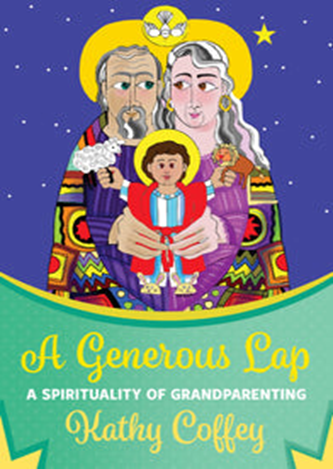
My most vivid image of the couple, understandably, appears on the cover of my book, A Generous Lap: A Spirituality of Grandparenting. With understated humor, artist Micky McGrath gave Anna big hoop earrings and both grandparents are cloaked in vivid symbols of mountains, sun and stars. Held in that cosmic embrace, the child Jesus endearingly wears bunny slippers to symbolize his resurrection, and holds tiny stuffies in his hands, the lion and lamb, of Isaiah 11:6. The title of the art, “Jesus Has a Sleepover with his Grandparents” places today’s tired, bewildered grandparents in a long and sacred line.

Anna and Joachim must’ve been puzzled when their daughter told them the strange circumstances of their grandchild’s birth. And Joseph’s parents must’ve looked for their son’s resemblance in the mysterious child. In short: confusion is OK, maybe even holy.

When Pope Francis established a World Day for Grandparents and the Elderly, celebrated on the Sunday closest to this feast, he must have been remembering his own Nonna Rosa. Rosa, her husband, and her son Mario had emigrated from Turin, Italy to Buenos Aires in 1929, fleeing poverty. Although it was high summer in the southern hemisphere, she wore her fox-collared coat for the journey because she had sewn in the lining the money from selling their family home.

Many consider Nonna Rosa the most important woman in Pope Francis’ life. Rosa lived around the corner from his childhood home in Buenos Aires, and looked after little Jorge as his four younger siblings were born. She continued to play an influential role until she died in his arms in 1970, when the future pope was thirty-four. When Cardinal Bergoglio moved to Italy to become Pope Francis, it brought his family history full circle. In many ways, Italian language, food, and customs must’ve felt familiar. His Nonna Rosa had prepared him long before for a life no one could have predicted. So too, grandparents have no idea what the century ahead holds for their grands—but they give them a firm foundation in love, a launching pad in care that can carry them far.

Let’s give the pope the final word here: “Grandparents are a treasure. Often old age isn’t pretty, right? There is sickness and all that, but the wisdom our grandparents have is something we must welcome as an inheritance.” And: “One of the most beautiful things… in the family, in our lives, is caressing a child and letting yourself be caressed by a grandfather or a grandmother.”[1]

Excerpts from A Generous Lap: A Spirituality of Grandparenting. Orbis Books, 800-258-5838, or website: https://orbisbooks.com/


[1] https://www.osvnews.com/amp/2021/07/08/pope-francis-offers-tip-of-the-zucchetto-to-grandparents-and-the-elderly/

Feast of Mary Magdalene–July 22

Let’s hope that on the Feast of Mary Magdalene July 22, we all do our part to correct the misperception of her as prostitute. That error, a conflation of three Biblical texts, was given authority by Pope Gregory the Great in the seventh century, and not corrected for 1400 years, until revisions to the Roman calendar of 1969.

Luke’s gospel names her as one of several financially independent women who supported Jesus’ ministry. But her role is more important than financier. Dan Brown’s best-selling Da Vinci Code gave her a romantic role, but again, her centrality in the early Christian community was more than simply a private relationship.

All four Gospels agree she was one of the first witnesses to the resurrection. When Jesus calls her name in the garden, it is a pivotal point of human history. Her name is the hinge to a new order. She was the first to realize that God could vanquish even death, and to tell the other disciples. She convinced them and skeptics throughout history that “love is stronger than death.” To silence her voice and discount her primary role does her a great disservice. She calls us instead to the vision of a world free of sexism, suffering, exploitation and death. Arguments over authority simply distract from that larger hope.


Sandaled but Stinky

Send-off scripts are fairly standard: “Got your phone? Don’t forget your keys/lunch/directions!”  That’s why Jesus’ parting with his disciples seems a bit off: he tells them what not to take. Some Christian churches will hear this weekend from Mark 6: no money, no food, no sack and no second tunic. Whoa—no clothing change in the heat of the middle east? They must’ve been a fragrant bunch when they returned!

Perhaps he wants them to avoid entanglements with the crutches that often buoy us up: our achievements, possessions, treats like the granola bar tucked away in the backpack.  Instead he focuses on what they do need: each other. Or as Pooh said to Piglet, “Life is so much friendlier with two.”

Although Jesus never mentions it explicitly, he too will accompany them. They must’ve suspected that presence and power when they cured the sick and cast out demons, actions way beyond their human scope. As Henri Nouwen points out, Jesus in John 15:15 doesn’t say he’ll reveal some of what he knows about the Father, but “everything that I have heard from my Father.” Furthermore, he promises: “You will do greater things than I have done.”

Life is often a balance between going forth and coming home. One wonders about the other bookend for this passage: the return. The disheveled bunch must’ve been hungry, eager to shower, relax, have a beer and tell tales of their adventures. Let’s hope they didn’t boast, but wondered what sort of mystery enfolded them. And who this was who’d sent them?

They may have remembered the psalm, “you lead me along right paths…” Totally unexpected, but absolutely marvelous trails. Do we have similar questions, parallel awe? We too can look back at stirrings in childhood or seeds in adolescence that materialized into lifelong attractions, interests or careers. We can recall familiar ways taken so often they wore grooves in our psyches and shoes—or those so breathtakingly new we had to read signposts in a foreign language. All the journeys of feet or mind part of a longer arc, pathways into God.

A Weekend of Different Worlds

How can one encounter radically diverse universes in two days, within an hour of home? God must find ways to stretch us if we ever grow too complacent or stuck in the familiar…

Let’s just say I didn’t go to the local car show intentionally, but the main road in town was closed for it, and I wanted to get to yoga. Made it there on foot, which gave me bird’s eye views of gentlemen displaying their cars. Many antique, all glistening. The hoods were open for engine inspection (though I wouldn’t know what to look for?) and the owners hovered nearby with white handkerchiefs, lest a speck of dust fall therein. Clearly a great amount of time and energy had poured into these vehicles. I must admit that I simply want my car to start and get me where I’m going with minimal fuss. In short, I don’t want to think about it. So the ardent devotion and dedication was a glimpse into another mindset.

Next day, I was overwhelmed in a different way, at Stanford University’s commencement. After the huge event for over 5000 students in the stadium, each department held their own smaller gathering in tents scattered around the campus. Tables were filled with abundant refreshments, background music played quietly, and the pride of parents was on full display.

It quickly became apparent why they were bursting at the seams. Many students seemed to be first generation, and a majority were women of color. They were pursuing fascinating research and futures full of potential. (One Latina for instance, after receiving her Ph.D. at Stanford, was going on to Harvard within the month for an MBA, then planned to open a non-profit. Some received their law degrees and Ph. D.’s simultaneously, and brought their knowledge to amicus briefs and AI.) Although I’d known in my mind that the face of higher education was changing, I saw it with my own eyes: among the 30 graduates at all levels in the Linguistics department ceremony I attended, only one white male. (Cue Bob Dylan: “And the times, they are a changin’…”) A sampling of backgrounds: Lakota, Hong Kong, Burma, Cuban part of Miami.

That might have been simply one department, but the impression was borne out afterwards, by the waves of students crossing campus: again, without a scientific count, many graduates were people of color. Their mothers dressed in garments unique to their cultures, wearing a wide variety of beautiful saris, elaborate embroidered aprons over long skirts, with their offspring in mortarboards decorated for individual ethnicities.

I hope what I saw there was the emergence of a tremendous force for good in some of the brightest youths at one of the world’s finest universities. Of course at such an event, all is potential: waving banners, displays of rich colors in academic hoods, balanced by long traditions, family and institutional launching pads built over generations.

Our worlds can grow narrow without our noticing—unless we’re lucky enough to have a large nudge and potent reminder that “in the Father’s house, there are many rooms.”

Showing Our Wounds–July 3

Let’s shift the focus on this Gospel slightly from the usual Thomas’ doubt to Jesus’ wounds. Clearly, Thomas was skeptical, but how does Jesus respond? Not with Mandatory Written Assent to the Doctrine of the Resurrection. Not with sly scolding. But with a “touch my wounds,” implying “touch yours too.”

Touch the wounds? Some of us hesitate to admit we even have them, but probing seems too intimate. Unless you know your own, Jesus might ask, how will you soothe another’s? How will you recognize—beneath the belligerent teenager, the contentious colleague, the arrogant pastor, or the cranky spouse—the hurting child? Will you intuit how many people in prison were victims before they became perpetrators?

Interestingly, there’s no record that Thomas actually touched the wounds. Maybe all he needed was for Jesus to see and accept him completely, his need for tangible proof, his shaky “outsider” status. We don’t know Thomas’ backstory—did a feeling of being “stranger and sojourner” prompt his arrogant demand?

The Adverse Childhood Experiences scale shows how childhood trauma leaves long-lasting scars. Adult behavior that seems bizarre may have been triggered by abuse or abandonment long ago. Even those lucky enough to have avoided early disaster understand Jesus’ question to Mary in the garden, “Why do you weep?” At some level, we all weep. Compassion for ourselves precedes reverence for the heartbreak many carry beneath the surface.

When we see ourselves and everyone else as limping and bandaged, that’s a step toward “the household of God” described in Ephesians. We are built together into God’s dwelling place through Christ Jesus, who is unafraid to show his wounds.

Kathy Coffey, “Showing Our Wounds” from the July 3,2024 issue of Give Us This Day, www.giveusthisday.org (Collegeville, MN: Liturgical Press, 2024). Used with permission.

PBS Documentary—”TEILHARD: Visionary Scientist”–Part 2

Back to the feminine influence on Pierre Teilhard de Chardin, unusual for a priest in his era to acknowledge. The first woman to play a major role was Marguerite, Teilhard’s cousin and childhood playmate. She was a rarity for women then—a brilliant student at the Sorbonne University in Paris, who studied under the noted philosopher Henri Bergson. She was Teilhard’s confidante when he served as a stretcher-bearer during World War I, the first listener to his ideas, his first audience and critic. Since 1 million died at Verdun, his time at the battlefield gave him a compulsion to write, fearing he might not return. Teilhard’s biographer Ursula King says of Marguerite, “without her, he might not have survived the war as well as he did.”

After the war, Teilhard enjoyed the intellectual circles of Paris, his teaching and doctoral studies, but his struggles with authorities stripped him of the life he loved. Deeply disappointed, Teilhard was exiled to China—which would ironically become a time of stimulation and flowering. International circles of scientists there transcended national and religious backgrounds; his field research led to the discovery of Peking man, a “perfect proof of evolution.” And he met Lucile Swan, a recently divorced North American sculptor.

They loved each other deeply; their relationship enriched what he called “our” work. Her influence broadened and deepened him. Lucile didn’t share Teilhard’s beliefs, so he stretched and expanded as he tried to articulate for her. She described him as alive and joyful, writing, “his ‘credo’… seems to me the best expression of a faith that I have yet found.” She found church censorship baffling: “his beliefs are so sane, intelligent and appealing to the world of today—which needs and longs for the very thing that he has to give.” She couldn’t understand his fidelity to the Jesuits, and hoped they’d kick him out so the couple could have a more “normal” relationship. He wrote her that his “internal evolution [has been] deeply impressed by you,” and felt lost after leaving Peking when they could no longer have their daily tea together. Teilhard promised Lucile that their love was forever, and perhaps its effects live on in his books.

Their relationship would change over time, but Lucile was one of the ten people at his funeral in New York City. After the communist takeover in China, he was exiled to the US, forbidden to return to his beloved France. He who wrote eloquently of the divine milieu was robbed of his own milieu. Sadly, this creative scholar and mystic was curtly informed, “No lectures. No publishing. Stick to Science.” Such a boycott led Teilhard to question himself, “has the vision been a mirage?”

Miraculously he maintained his astonishment at the juice of life. His biographer Kathleen Duffy writes in Teilhard’s Mysticism that “something as simple as a song or sunbeam would…heighten his awareness of an unexplainable presence.”(23) In a letter to the Father General trying to explain where he stood, Teilhard wrote, “what might’ve been taken as obstinacy or disrespect is simply the result of my absolute inability to contain my own feeling of wonderment.” Even at the end he was dazzled by beauty; one of his favorite words was “sap,” for the divine energy welling up through appearances. And to their credit, the Jesuits have done a complete turn-around; they are among the sponsors of the documentary streaming for two years on PBS and website, https://www.teilhardproject.com.

PBS Documentary—”TEILHARD: Visionary Scientist”–Part 1

No wonder Pierre Teilhard de Chardin made the Vatican nervous. They must’ve had their knickers in a knot over a Jesuit priest who wrote shortly after World War I, “I have experienced no form of self-development without some feminine eye turned on me, some feminine influence at work.”                    

And that wasn’t even what flummoxed the hierarchs who condemned his new ideas. They simply couldn’t handle Teilhard’s three alternative ways to think about original sin, or joy in the dynamic process of evolution, when their theology was medieval, static, entrenched.

But to start with the controversy jumps too far ahead. Let’s focus for now on a stunning new documentary, ten years in the making, filmed in a total of 25 locations where Teilhard lived, including more than 35 interviews and archival footage. Reading Teilhard is rewarding and can also be difficult, but the film clarifies his key insights with marvelous directness. After watching it, I went outside in twilight to look in wonder at the luminous full moon, the distant hills and sculpted cypresses. My prayer was simply, “Thank you God for Teilhard.”

I’d been reintroduced to his writing earlier this year by the splendid work of Sister Ilia Delio, Franciscan theologian. Interviewed in this documentary, she points out that Teilhard was way ahead of his time. Now, the PBS film by co-producers Frank and Mary Frost makes him accessible to an audience far beyond his era (1881-1955) and the realm of churchgoers. This broader audience is appropriate, since The Divine Milieu was originally written for “waverers.”

Teilhard’s mother gave him traditional Catholicism, and his father, walks in the woods to explore the geology of the Auvergne, France. When his mother was cutting his hair by the fire, Pierre at six noticed how quickly the locks that fell in burned, and began his life-long search for something more permanent. He turned first to iron, but found it would rust. Then he found rock which lasted—and a distinguished career as a geologist and paleontologist.

His scientific studies created tension with a religion whose dominant teaching then was contempt for the world and flight from it. He loved the earth and found God’s fingerprints in all his explorations. He saw Christ at work in unfinished creation, drawing all matter to himself; as humans make the evolutionary journey into God, God “humbly becomes increasingly incarnate.” The work of human hands, nothing scorned, contributes to this gradual unfolding. Teilhard would often use the word “zest” to refer to “the spur or intoxication of advancing God’s kingdom in every domain of humankind.”

Field research–riding mules for weeks into the Chinese desert and sleeping in tents–didn’t bother Teilhard , because he was captivated by his quest for fossils and rocks that would tell the human story. What devastated him were the criticisms, silencings and exiles enforced by Vatican officials and Jesuit superiors. Previously, friends had described Teilhard as exuberant, charming, vivacious, kind.  But his close friend Pierre Leroy, S.J. (the only one to accompany his body to the burial site) described him as “bereft and broken” when he realized around age 70 that his major works like The Divine Milieu and The Phenomenon of Man couldn’t be published in his lifetime.

As a writer, I can’t imagine the pain and frustration of being forbidden to publish. For someone whose ideas were ground-breaking, prophetic, an infusion of life the stale church desperately needed—devastating. He wanted the church to embrace the gift he offered, but that came only after his death. Fortunately, he’d willed his work to his secretary who got it published immediately. Many have speculated that if it’d gone to the Jesuits, it might’ve vanished into the archives or been destroyed. Sales of his books skyrocketed; he was recognized by four popes; his influence and phrases are found in Vatican II documents and “Laudato Si,” Pope Francis’ encyclical on the environment.

To be continued next week in Part 2.