Humanity and Vinnie’s Pizzeria

Vinnie’s Pizzeria in Brooklyn, New York (https://www.vinniesbrooklyn.com) is an inventive place that, among other creative concoctions, features a small, round pepperoni pie served in a square, custom box made out of pizza. But they’ve outdone themselves with their latest innovation, which has made the national news. Kindly, they checked with their delivery staff before offering it. Now, for $1 extra, the pizza delivery person will look the customer straight in the eye and say, “It’s going to be alright. You’re doing the best you can.”  

As a friend pointed out, it echoes the message from 14th century mystic Julian of Norwich: “All will be well.” How desperately we long to hear that now, and how I wish our churches, mosques and synagogues had said it first. Isn’t that our business, to reassure people in the midst of terrible times, which are harder on some than we can even imagine? And why has Vinnie touched a chord, some deep yearning of so many? One answer might be the tone deaf lack of civility, even common courtesy, in the national leadership.  

Another writer who seems to frame this longing is Elayne Griffin Baker. As she wrote in the newsletter of the Charlotte County Democrats 9/23/20
(www.charlottedems.com › no-joy-in-the-white-house)

“There is no literature or poetry in this White House. No music. No Kennedy Center award celebrations. There are no pets in this White House. No loyal man’s best friend. No Socks the family cat. No kids’ science fairs. No times when this president takes off his blue suit-red tie uniform and becomes human, except when he puts on his white shirt-khaki pants uniform and hides from Americans to play golf. There are no images of the first family enjoying themselves together in a moment of relaxation. No Obamas on the beach in Hawaii moments, or Bushes fishing in Kennebunkport, no Reagans on horseback, no Kennedys playing touch football on the Cape.

I was thinking the other day of the summer when George H couldn’t catch a fish and all the grandkids made signs and counted the fish-less days. And somehow, even if you didn’t even like GHB, you got caught up in the joy of a family that loved each other and had fun. Where did that country go? Where did all of the fun and joy and expressions of love and happiness go?

We used to be a country that did the ice bucket challenge and raised millions for charity. We used to have a president that calmed and soothed the nation instead of dividing it. And a First Lady that planted a garden instead of ripping one out. We are rudderless and joyless. We have lost the cultural aspects of society that make America great. We have lost our mojo, our fun, our happiness. The cheering on of others. Gone. The shared experiences of humanity that makes it all worth it. Gone. The challenges AND the triumphs that we shared and celebrated. The unique can-do spirit Americans have always been known for. Gone. We have lost so much in so short a time.”

One of my favorite non-violent acts of resistance was the Australian choir who broke into Parliament as they debated getting embroiled in the Iraq war. The choir sang lamentations. That might be a good choice for us right now.
St. Teresa of Avila’s Feast—Oct. 15

“From silly devotions and sour-faced saints, Good Lord deliver us!”

“May God preserve us from stupid nuns!” –Teresa

No matter how hard they try, hagiographers can’t camouflage Teresa’s tart brusqueness. In her day, the sixteenth century, the Inquisition tried to force change through threats, imprisonment and violence. One suspects that Teresa’s humor had longer-lasting effects.

She reformed not only the Carmelite order, but also attitudes about women and approaches to prayer. Because her early training had shoe-horned her into trivial conversation with too many women jammed into one house, she created orderly spaces where her sisters could turn inward. “My daughters, we are not hollow inside,” she reminded them.

Then she took on the prevailing ideas of prayer: mindless repetition of rote formulas imposed by the clergy. Most people considered direct experience of God, without priestly intervention, subversive. Teresa gave images of contemplation that were close to daily life: the watered garden, beehive, interior castle, heart of God like the innermost, edible core of the palmetto. The face of God that Teresa reveals is not punitive or distant, but precious as a lover, close as a friend.

All the while she was dancing around the Inquisition, coyly claiming she had no idea what she was talking about. How could others condemn her when she beat them to it? Meanwhile, probably grinning self-protectively, she focuses on God’s generosity: “Do you think it’s some small matter to have a friend like this at your side?”

V.O.T.E.

Rarely has voting been more important, I tell myself as I write postcards and letters to places I’ve never heard of: Falfurrias, Beeville, and Flower Mound, TX? But they matter: in a swing state, everyone must vote. Next I write the number to locate the early polling place; my 7-year old assistant highlights it and affixes a stamp. Some friends’ hands are too crippled by arthritis to write encouraging letters or postcards. But they have sworn to be on the phone until Nov. 2 if that’s what it takes. It’s tedious work, and the results are iffy, but I respond viscerally to the ideal offered by Joe Biden, first voiced by the Irish poet Seamus Heaney: This is our moment to make hope and history rhyme.

Recent history has been a sad mess, and let’s not forget that even before the pandemic, federal agents were separating children and parents at the border, consigning them to cages. ICE and for-profit detention centers have treated desperate refugees despicably, in no way aligned with the gospel of a welcoming  Christ. And despite the pandemic, the threat to the Affordable Care Act could jeopardize health insurance for millions. Don’t even start on climate change—I’ve written other blogs about that. These are a simply a few reasons, plus the official refusal to condemn white supremacy, that underscore the importance of voting.

As Biden (I’m honest about my preference) said in his acceptance speech Aug. 20:

“Character is on the ballot. Compassion is on the ballot. Decency, science, democracy. They are all on the ballot. Who we are as a nation. What we stand for. And, most importantly, who we want to be. That’s all on the ballot.”

Thomas Friedman, a New York Times columnist, wrote a fine commitment to voting. Here’s an excerpt for those who missed it:  “I will skip, I will crawl, I will slither, I will bike, I will hike, I will hitchhike, I will fly, I will roll, I will trek, I will trot, I will truck, I will boat, I will ramble, I will amble—and I will wear a face mask, a face shield, gloves, goggles, a hazmat suit, a space suit or a wet suit—but I damn well will get to my neighborhood polling station to see that my vote for Biden and Harris is cast and counted on Nov. 3.”

On display during the first presidential debate was petulance and arrogance (ignoring a two-minute time limit?) poised against compassion for human suffering. As Biden said eloquently, “over 200,000 people woke today to an empty chair at the kitchen table. Countless others tell mom or dad goodbye while a nurse holds up the phone.” This is the language we’ve longed for: not ignorance, contempt or self-aggrandizement in the face of a tragic crisis. But simple humanity at the highest levels of government. It seems so little to ask, but our vote is our voice and our power. Let’s not squander it.   

Book Review: The Overstory

The best argument in the world won’t change a person’s mind. The only thing that can do that is a good story.”

As fires devastate over 3 million acres in California, Washington state’s air is “hazardous” because of burning forests, and over 500,000 people have been ordered to evacuate due to fire danger in Oregon, it’s time to read The Overstory. Fair warnings: Richard Powers’ Pulitzer Prize winning novel is not an easy read. Some highly intelligent friends found it too long, depressing, convoluted. And it will leave you unable to walk oblivious beneath a forest canopy ever again. The ultimate tribute, as Powers told the Chicago Review of Books: “I just want to walk, look, listen, breathe, and write this same book,” from different angles and perspectives.

He recreates a genre of literature which challenges the notion of human separation from the environment, as the former Stanford professor tells a PBS interviewer: https://www.pbs.org/newshour/show/the-overstory-author-richard-powers-answers-your-questions. The book’s astonishing scientific data about trees, discovered during the last 30-40 years, is verifiable. To our peril, only 2-5% of US old growth forest remains, and we’re clueless about the mystery and magnificence we have destroyed.

Humans share significant amounts of DNA with trees and through books like The Hidden Life of Trees  by Peter Wohlleben, we’ve learned the scientific processes of how they communicate, support and nurture each other,  protect against assault through their vast root systems. Powers brings an enhanced reverence to the topic, underscoring how some leviathan redwoods are “old as Jesus or Caesar.”  As Powers says, we live in an extraordinary moment, suddenly realizing our grief over what we’ve done to the natural world.

At first the human stories seem as tangled as the undergrowth. But gradually, the connections emerge. To focus on one: A young woman, Mimi Ma, adored her father, who kept meticulous records of every camp site his young family visited in the national parks. The perfume of pine brings back her childhood’s “only untouched days,” and the memory of her father after his death. “She falls into the smell, a devastating whiff of over two hundred million years ago. .. until she and the dead man are fishing side by side again, under the pine shade where the fish hide, in the soul’s innermost national park.” (p.183)

What a lovely phase for the soul’s vast inner expanses, filled with abundance: peaks, firs, wild strawberries, waterfalls, lakes, campfires, clear stars, panoramas, quiet, columbine, cedar, green valleys, birdsong, sun-dappled trails beside streams, deer, stunning vistas, golden meadows, chipmunks, overlooks, sunsets, picas, granite, soft dust, aspen, crashing waves, bubbling wells. Other lyrical phrases: “the bronze spears of beech buds,” “the polite applause of aspens. A yew reaching out, like a parent taking a child’s hand.”

Mimi and four others converge on a legacy tree “five times larger than the largest whale.” (p. 264)  In one day, this mammoth eats four pounds of carbon from the air, in the natural cleansing cycle humans seem hell-bent on destroying. Two live on platforms in its uppermost branches trying to protect it from a logging company.

They fail, but years later in jail, imagining the questions, “Why didn’t you do something? You who were there? How can humanity unsuicide?” can answer with integrity, “we tried.” How bizarre and infuriating that logging companies greedily devastating national forest, which supposedly belongs to the people of the US, are legal, but environmental activists trying to save it must face police, pepper spray poured into their eyes, and prison terms.

The shared humanity of loggers and environmentalists surfaces in poignant moments, though. One occurs when a tree-sitter tosses down his sketches of lichen, huckleberries and pools, and the loggers are impressed at the life forms that flourish two hundred feet above ground. Another comes after a howling storm, when the loggers appear at the base and confess, “we were worried about you.”  (p. 296)

Towards the end, the novel crescendos into sacred text.  One character, dying from an act of botched eco-terrorism, assures her comrades, “what we have will never end” in an echo of the last supper. Another goes to jail, accusing himself, “He didn’t look hard enough. He loved too little.” By doing his time, he saves the woman he loves from a similar fate, but consigns Adam, a collaborator, to a life-long prison sentence.

Adam, like a modern Thomas More with a “heart as good and worthy as wood” feels “If I save myself, I lose something else.” His sacrifice of teaching profession, wife and son re-writes salvation history in another, 21st century key. And the resurrection? Surely it comes through the trees called “sempervirens,” which scientists tell us will survive fires that break open cones of seeds that couldn’t open any other way. The novel quotes the poem:

For there is hope of a tree, if it

goes down, that it will sprout again,

and that its tender branches will not cease.

Reading the book challenges our unconcerned life styles, and may put us in the same mental frame as John Muir, whose love of Yosemite led to making it the first national park. He once admitted, “I only went out for a walk…”

For Shame! Another Injustice

Really, LAPD? Does it take 5 or 6 deputies to tackle a 95 lb. reporter, pinning her to the ground and arresting her for doing her job, simply because you perceived she might get in your way? That’s what happened Sept. 12 to Josie Huang, who clearly wore her press credentials and verbally identified herself as she covered BLM protests in Los Angeles. She was arrested around midnight, finally released around 4 am with a charge of obstructing a peace officer. (Is the irony in peace officer intentional?)

Full disclosure: Josie’s mother-in-law is one of my oldest friends, her husband is my godson, and I attended her wedding. She is a respected, award-winning journalist for KPCC and The LAist who covered the sheriff’s press conference at the hospital where two deputies underwent surgery after they were shot.  The mother of two toddlers herself, Josie recorded, “One of the deputies is a mom of a 6 year-old. I felt my chest tighten thinking about the little boy.”

As she was wrapping up her shift around 11 pm, Josie noticed a disturbance in the street: protestors taunting cops. One officer pointed a weapon at them. As she filmed a subsequent arrest, deputies yelled at her to stay out of the way, but she could find nowhere to go. The rest was filmed on this disturbing video:
https://www.youtube.com/watch?v=JcDUtzQUfIc&feature=youtu.be
  

The downward spiral is clear: two deputies simply sitting in a patrol car are seriously wounded by gun shots—another act of violence caused by the ridiculous, free access to weapons unique to the US. Other cops gather for a press conference at the hospital where the wounded are being treated. Obviously, they’re on edge—but must one point a gun at a demonstrator simply waving a flag? The simmering anger and blame suddenly shift to the wrong person, an innocent reporter. But the overkill is unjustified: five or six cops brutally  forcing a slight, unarmed woman to the ground, handcuffing her, ignoring her repeated protests that she is with the press.  

But in Trump’s US, press credentials don’t much matter.  Josie’s story is one of many, as journalists covering protests this summer have been consistently targeted.  In 2020, 190 journalists have been attacked, 61 journalists arrested, and there have been 800+ reported aggressions against the press during BLM protests. AS NPR’s official statement pointed out: “Huang, a KPCC public radio reporter was performing her job last night—gathering facts to inform the American public. The rights of journalists are protected by the First Amendment, essential to an informed public and our democracy.”

So this incident, aside from its personal connections, raises larger questions. First: without the press, where do we get the information vital to responsible citizenship? Second:  if police are this brutal with a respected reporter, how are they treating anonymous, powerless people of color?  
     

Places to donate to help protect journalists:

The Future We Want for Elly Wicks

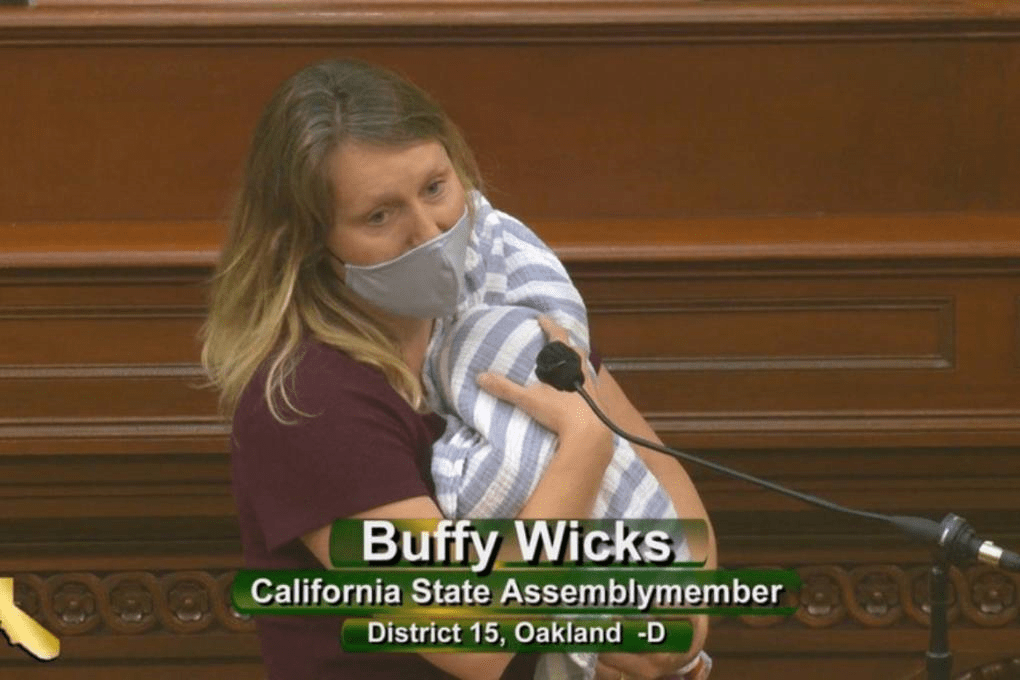
At the age of one month, Elly made history. For those who missed the cringe-inducing coverage, her mom, Assemblymember Buffy Wicks drove the hour and a half from Oakland to Sacramento with her newborn on Monday, August 31. She made the trek to debate legislation she considered vital: creating more multi-unit housing in a state desperate for it, and expanding family leave protections.

When the housing bill came up near midnight, Wicks who was nursing, literally “detached” from her daughter and ran down two flights of stairs with a blanket hastily thrown over the whimpering child. “Please, please, please pass this bill,” she said on the Assembly floor, holding the swaddled baby. “And I’m going to go finish feeding my daughter.”

She’s not a drama queen. She did it because California Assembly Speaker Anthony Rendon had decided only Republicans exposed to COVID could vote by proxy–not new moms. He was apparently oblivious to what politico.com reports: “Postpartum mothers could experience a slew of health issues that would qualify them as immunocompromised, putting them at a higher risk [for COVID].” 

Let’s hope that legislators strolling on the golf course stopped short, stunned  to see how seriously some representatives take their job. How moving that Wicks feels “beholden, not just to our children — but for all the children who will come afterwards.” With a mom like that, Elly can’t go wrong.

Buffy Wicks’ photo—slightly disheveled but committed—rings bells for a lot of us. I was fortunate enough to stay home with my infants, and grateful to a department chair who covered my weekday college classes for a semester, offering me the chance to teach on Saturdays when my husband, who worked all week, could babysit. But even with those cushions—placed in situations where I had to choose between career and baby, I’m embarrassed to admit I often chose the former. How unimportant the deadline or the meeting or the phone call seems in retrospect, compared to the miracle of my four children!

But the future for Elly is different, I hope. After the news got out, working moms went ballistic, with 25,000 references on Google alone and news coverage from as far as Lima Peru, where El Comercio called Wicks the hero of “la lucha de las madres trabajadores” (the struggle of working mothers). Rendon apologized but the damage was done; the cry had gone forth: “What century does he live in?”

While 70% of women in the workforce are moms, family leave policies in the US are pathetic compared to other nations. The United States is one of a “handful” of countries among the 193 who belong to the U.N. that does not have a national paid family leave program. 

Ah Elly, we have much work to do to humanize our society, making it worthy of our children. By the time Elly is a nursing mother, protections should be in place so moms never have to make the outrageous choices Buffy did. What for women has too long been a question of either/or can become a both/and. As one Republican senator commented in the film “Miss Representation,” “if the women in Congress could just get together, we’d  pass family leave protections quickly.” Welcome to a more just, humane world, Elly! To Rendon and the ol’ boys club: “Your day is done. You had your chance. Your time has passed.”


First Death Certificate of 9/11—Fr. Mychal Judge

Someday it may seem mild, but a priest who openly admitted being alcoholic and gay, then went rollerblading in his sixties was pushing the narrowly defined boundaries of priesthood in the seventies and eighties.

At one time, Mychal Judge drank so heavily he had blackouts. The drinking began in the seminary with little sips of altar wine. By 1976, “his alcoholism had become so serious that it became both crisis and opportunity.” After joining AA, Judge later attended as many of its meetings as he could. Some thought he was more familiar with the AA book than with the Bible.

The risk was dramatic at a time when “if a friar had drinking problem, it was hushed up or he was sent away for therapy.” So too for his second frontier: being gay. Judge was open about his gender preference even at a time when Archbishop O ‘Connor was quoted in the  New York Post as saying, “I would close all my orphanages rather than employ one gay person.” At first hesitant to march in New York’s first inclusive St. Patrick’s Day parade in 2000, Judge received wild acclaim from the crowd—and nervous disapproval from the church.

That continued when he was reported to the diocese for not wearing vestments at firehouse Masses. Judge told the young clerical bureaucrat who called him on the carpet: “if I’ve ever hurt the church I’ve served and loved so dearly for 40 years, I want to be burned at the stake on 5th Ave., at the front doors of St. Patrick’s Cathedral.” “No matter how many robes Cardinal [O’Connor] put on or how much power he tried to exert, he still could not… quash Mychal Judge.”

The story of his death is well known: Judge rushed to the World Trade Center to be with the fire fighters responding to the disaster. Some speculate that he removed his helmet to pray the last rites over a dying firefighter, was struck on the head by debris and died. Five rescue workers carried him out through the rubble; Shannon Stapleton’s photo of them was widely published. (His friends joked that even in death, Mychal still loved a photo-op.) Firefighters laid Judge’s body before the altar in a nearby church, covering it with a sheet, his stole and badge. His eulogist pointed out how appropriate it was that Judge died first; then he’d be in heaven to meet over 400 first responders who arrived later.

Judge’s biographer comments on the impromptu ritual of two cops praying over his body at Ground Zero. It’s not only OK for laity to give last rites in an emergency. It “was, in fact, entirely in keeping with Father Mychal’s own sacramental theology of hallowing the moment and was typical of the way ordinary people generated light in the darkness of that day.” The overflow crowd outside Judge’s funeral proved what his eulogist said: “When he was talking with you, you were the only person on the face of the earth.. . . We come to bury his heart but not his love. Never his love.”

Excerpt from When the Saints Came Marching In by Kathy Coffey, Liturgical Press, 800-858-5450


Why Care about Creation?


Throughout history, church bells have invited people to worship and celebrate, as well as rung out warnings of danger like invasion or fire. On Sept. 20, 2019, they rang in solidarity with the climate strike of 4 million young people in 150 countries. Some rang for 11 minutes, signaling the 11 years scientists say we have to limit global warming to a maximum increase of 1.5 degrees C, or risk catastrophic loss of lives. Why should people of faith care about the current climate crisis? Why should they, in fact, see it as a burningly relevant question of justice?

Answers to that question lead us back to the psalms, ancient Celtic and Native American spirituality, St. Francis of Assisi who would sing in wonder at moon, stars or sun, and writers like St. Bonaventure, who said creation was God’s first book, leading us back to God if we “read” it properly. Today, Pope Francis’ letter “Laudato Si” is an eloquent plea. “The cry of the Earth and… the poor cannot continue,” he wrote there. If we don’t see creation as sacred, it’s much easier to exploit and destroy it. As the pope points out, we must love the beauty of our world or we’ll treat it like “consumers or ruthless exploiters.”

The faith community can be an effective force for change in the environmental crisis. Surely 1.2 billion Catholics and 2.2 billion Christians, united in stewardship, could make a difference. Many churches already take the lead: converting to solar or wind power, changing parking lots into community gardens, divesting from fossil fuels, investing in alternate energies, minimizing plastic waste, educating parishioners and neighborhoods about their carbon footprint.

Furthermore, climate change dovetails with other social justice issues because it has the worst effects on the poorest. People of color suffer higher rates of asthma and cancer, disproportionately affected by air pollution caused by industrial plants in their neighborhoods. Drought in Africa has led to starvation, forcing more refugees into exile. For their sake, and for future generations, the question rings with maddening frustration: If we could use almost-free, renewable, natural power sources like solar, wind, geothermal or hydro-electric, why would we choose toxic, diminishing fossil fuels instead?

“The young remind us that the earth is not a possession to be squandered, but an inheritance to be handed down,” said Pope Francis, affirming Greta Thunberg, outspoken climate activist, the first to strike in her native Sweden. At Davos in Jan. ’19, she challenged the World Economic Forum: “I want you to act as if the house is on fire, because it is.” Will the faith community act as decisively and respond to the climate crisis as brilliantly as this young girl?

MORE Methane?

In a week of stunning news (de-fund the Post Office to prevent mail-in votes, disenfranchising voters??), a staggering notice from the EPA may have escaped peoples’ attention—and it’s simply one of over 100 environmental regulations weakened since 2016. Their plan to eliminate methane regulation will release an estimated 850,000 tons of the planet-warming gas into the atmosphere during the next 10 years. And their excuse? To save the oil and gas industry, the largest source of methane emissions, about $100 million a year through 2030. Meaning: we are not channeling money to the hungry nor unemployed, but to the fossil fuel billionaires, not coincidentally big financial backers of the current administration.

“Methane is the main ingredient in natural gas. But when it’s released before it burns, say from a leaky valve at a drilling site, it’s far more potent than carbon dioxide,” reported npr.org on August 13. Here’s the irony: while smaller oil and gas companies do find the costs of regulation excessive, the big producers don’t even want the concession. “The negative impacts of leaks and fugitive emissions have been widely acknowledged for years, so it’s frustrating and disappointing to see the administration go in a different direction,” said Gretchen Watkins, Shell Oil’s US president.

She sounds like Pope Francis, who said in “Laudato Si”: “We know that technology based on the use of highly polluting fossil fuels – especially coal, but also oil and, to a lesser degree, gas – needs to be progressively replaced without delay” # 165. Scientists say we have 11 years to limit global warming to a maximum increase of 1.5 degrees C, or risk catastrophic loss of lives. The proposed addition of methane, along with the other gases, could warm the atmosphere by 3-4 degrees. And many scientists believe methane leaks are 2 to 3 times higher than the EPA estimates!

Even for one whose science background is as pathetic as mine, a basic understanding means that the greenhouse gases (carbon dioxide, methane and nitrous oxide) trap the sun’s heat, melting the polar ice caps and warming the oceans. Most of the emissions are CO2, but methane, in its first 20 years in the atmosphere, is 84 times more potent. Most know the disastrous effects. As sea levels rise, the weather that results leads to drought in places, and massive flooding that could destroy coastal areas and islands.

Signs of hope: state regulations, the industry’s policing itself since leaks are expensive and dangerous, investors’ sensitivity to bad PR, the Natural Resources Defense Council and Environmental Defense Fund’s plans to sue, the hope of a more far-sighted president taking office in January. As for the agency designed to protect the environment? “Give an account of your stewardship.”

Why does a blog about spirituality veer precipitously into science? For the answer, see next week…

Masks

Two young grandchildren arrive at my door, looking like masked bandits, giggling with delight. They’re excited about today’s “field trip” to a children’s museum that’s moved some of its offerings outdoors. It requires masks of children over five, and this five- and seven-year old are trying to comply.

The widespread (we hope) wearing of masks sets off thought that dovetails with Matt Malone, SJ’s insight that when God found Adam and Eve hiding in the garden, ashamed of their disobedience, God asked, “Who told you that you were naked?” (Gen. 3:11) Fr. Malone hears the question not in a “Charlton Heston” booming, accusatory voice, but in a plaintive lament, “Aw—who told you? There goes all your innocent beauty!” Then God makes clothing for them (Gen. 3:21), as any protective mother would do, sending children into searing heat or chilling cold, knowing fig leaves just won’t do it.

These garments were temporary—until humanity could be clothed in Christ. To restore our confidence, writes Fr. Michael Casey in Balaam’s Donkey, “God has chosen to be unveiled before us. Jesus is the visibility of the unseen God…He calls us to come out of the bushes and be seen as we are, no longer fearful of rejection but confident that we are held in God’s all-embracing love.” Redeemed, we need no longer feel ashamed.

Back to the masks. The pandemic creates a different form of “naked,” for we are stripped of  our professional and social activities. The usual errands and exercise are gone; we can’t attend a concert or play, give a presentation or retreat, go out for dinner, plan air travel. So little adult agency is left—it’s questionable if we can safely hug, shop, or ride in a car with a friend. How shrunken we seem, how much is lost, how fragile our flimsy masks.  Depression like Michelle Obama’s is natural. It’s a pervasive joke that we live in sweats, the dressier clothes forgotten in the closet.

Jesus’ take on clothes was “consider the lilies.” Maybe we had to re-learn we were precious without the usual accoutrements. God calls us to an identity deeper than suit, better than ball gown. When held in an all-encompassing  love that keeps us alive and united, does it really matter what we wear?