Category Archives: Family Spirituality

Joy for July

Today’s reading from Isaiah 66:10-14 imagines God saying, “Rejoice with Jerusalem and be glad because of her, all you who love her; exult, exult with her…When you see this, your heart shall rejoice.” Why is the note of joy often sadly missing from some religious celebrations? It permeates the Hebrew scriptures and New Testament, yet “churchy” folks often seem grim. Thomas Merton describes them in Disputed Questions: “the painful coldness and incapacity for love that are sometimes found in groups of men or women most earnestly ‘striving for perfection.’” That phrase may seem dated, but this sounds burningly fresh: “the failures of those who are so sincere, so zealous, and yet frighten people away from Christ by the frozen rigidity and artificiality of their lives.” (p. 124)

Merton goes on to explain that Christ’s call wasn’t meant to be another difficult duty to satisfy the demands of God, but to enter Life, and by loving “be transformed from brightness to brightness.”  As we allow ourselves to be loved, in our limitations and messiness, we “stop being a hair-splitting pharisee,” and become a new reality.

I often find parallels to scripture in literature, this time in re-reading a favorite classic, Death Comes for the Archbishop by Willa Cather. She recounts the story of Bishop Lamy, with the pseudonym Jean Latour, who as a young man left his home in the beautiful Auvergne region of France to become a missionary in New Mexico. Travel was arduous, living conditions rough, and he often missed his cultured French home. But one achievement of his years on the frontier was building the beautiful cathedral of Santa Fe, dedicated in 1887. As he’s dying, he looks back on his rich, full life. He’d had the chance to retire in France, but opted instead to die in New Mexico. Why? A deep breath of the morning air that restored youth: “the light, dry wind… with the fragrance of hot sun and sage brush and sweet clover … that made one’s body feel light and one’s heart cry, ‘today, today’ like a child’s… (p. 443).  Something soft and wild and free… lightened the heart… and released the spirit into the wind, into the blue and gold into the morning, into the morning!” Or as Merton would say: The mystery of Christ shines forth in our loves, and “we breathe the sweet air of Christ, the breath of Christ.” (p. 126)

Vive the Counterculture!

Writers often work a year out, so the last blog published about Pentecost was written before I attended a celebration of the feast so lively it has stayed with me for weeks, continuing to resonate.

Imagine St. Therese Parish in Seattle, WA at 9 am June 8. The altar cloth suggests flames of crimson and gold. Above the altar, fabric in the same colors blows in the breeze.  Vestments are a bold scarlet, and most participants wear red or orange. The choir is spirited, their music vibrant and pulsing. But what really strikes me is the homily by Father Phil Boroughs, SJ.

He recalls saying Mass for a group in the crypt of St. Peter’s. They arrived at 6 am, before the basilica opens, and were escorted to their spot by the Swiss guard. As they walked the circle around Peter’s tomb, they saw other groups from around the world, celebrating in many languages.  That scene in Rome echoed one in Jerusalem centuries before when visitors from many lands voiced their astonishment:

“Are not all these people who are speaking Galileans?
Then how does each of us hear them in his native language?

We are Parthians, Medes, and Elamites,
inhabitants of Mesopotamia, Judea and Cappadocia,…

yet we hear them speaking in our own tongues
of the mighty acts of God” (Acts 2:7-12).

It struck then: the universality of the Catholic church is the antidote to the ridiculous effort of the US administration to quash diversity. In some misguided, racist attempt to create a whites-only world, they have ordered international students to go home. At Harvard, for example, 6,700 students from around the world bring a rich blend of different cultures and experiences that benefit all the students. Who knows: might one of those students from abroad return home and eventually become a Prime Minister with friendly ties to the US? Might one, exposed to cutting edge science, come closer to researching a cure for cancer or Alzheimer’s?

As some readers may remember, I haven’t always been a fan of the patriarchal hierarchy suggested by the massive, heavy architecture of the Vatican. I searched in vain for some trace there of the poor carpenter who began it all. But from another angle: “And they were all filled with the Holy Spirit and began to speak in different tongues” (Acts 2:4). Humans can evolve beyond tribalism, beyond suspicion or hatred of anyone different. The insecure and anxious fear the ”other.” But many, despite differences, unite in common cause, with the same hopes, ideals, values and leader. The languages and cultures gathered in St. Peter’s reflect the vast diversity of God’s creation: 400 kinds of mangos, 11,000 species of birds, between 5.5. and 30 million insect species, 4000 kinds of potatoes. If God so loves variety, why don’t we?

Three Parades

It’s raining lightly on a grey June 14 in Washington DC as the grim parade rolls past the scowling birthday boy. Such a display of military might, power and dominance reeks of insecurity. It’s sad when someone must order over 6,000 soldiers to celebrate his birthday. What’s tragic is the bill for this extravaganza: by some estimates, over $45 million when $1 a day which can keep a child from starving in Sudan has been de-funded. The brash arrogance of it all cried out for a recitation of Psalm 75, used that day for morning prayer around the world:

“To the boastful I say, ’Do not boast’;

To the wicked, ‘Do not flaunt your strength,…

Do not speak with insolent pride.’”

Contrast that scene to parades all over the U.S., in small towns and large, where five million gather to protest “No Kings.” (Asked about it, the president replied, “We’re not a king,” inadvertently using the royal “we.”) Spirits are high; drums, speeches and chants uplift the crowd, and the home-made signs, with varying degrees of wit and artistry, convey the same message in many modes. A few favorites: “It must be bad when the introverts are here.” “We can afford tank parades but not Medicaid?” “Defrost ICE,” and “Remind me: which felonies lead to deportation and which to the presidency?” A mom with a toddler in a stroller and a baby in a Snugli on her chest carries a heartbreaking sign: “The Children Deserve Better.”

The tone of the latter parade was overwhelmingly human, quirky, compassionate. No one marched in step; no one stayed in straight lines. There was good reason for anger that week, especially in California, with the unlawful calling of the National Guard and Marines to pour kerosene onto the flames of unrest in Los Angeles and the ham-handed treatment of Senator Alex Padilla, thrown to the floor and hand-cuffed when he tried to ask Homeland Security Secretary Kristi Noem a question at a press conference. But almost all reports were of peaceful, nonviolent demonstration.

The whole experience left me feeling bolstered and affirmed that, “I’m not alone and I’m not crazy.” Further adding to this was an editorial by Pedro Rios about masked and militarized ICE agents arresting workers at an Italian restaurant in San Diego. In the midst of Neopolitan pizza, people walking their dogs and children playing: helmets, rifles and flashbang grenades? To their credit, the neighbors and restaurant patrons told the agents in “colorful language that they weren’t welcome.” As one observer said, “unmarked cars took away people who have been part of the fabric of this neighborhood for years.”   (“How ICE raid affects California neighborhood” East Bay Times, June 15, 2025,) 9

The sheer cruelty of this government-sanctioned, racist violence reminded me of what Thomas Merton wrote in Disputed Questions, first published in 1953:

“So when as in our time, the whole world seems to have become one immense and idiotic fiction, and when the virus of mendacity creeps into every vein and organ of the social body, it would be abnormal and immoral if there were no reaction. It is even healthy that this reaction should sometime take the form of outspoken protest.” p. 194

Of course there is historical precedent for flaunting military power: the Roman Empire displayed its legions, armor and swords with imperial majesty, ruling by force and terror.  Especially at Passover in Jerusalem, their march reminded the Jews they’d obliterate the oppressed people who tried any resistance. But at the same time, another small parade occurred: a ragtag group followed a man looking absurd on a donkey. As Deb Thomas points out in Into the Mess and Other Jesus Stories, “Jesus comes defenseless and weaponless into his kingship.”

 Furthermore, he has the audacity to love the sociopath who so unfortunately governs the U.S. Which parade might he join? Or perhaps his stands alone and unique, a subversive and mysterious invitation.

John Muir: the Last Chapter

“And I was beside [God] as a craftsman, and I was [God’s] delight day by day, playing on the surface of [God’s] earth…”

On a particularly gorgeous stretch of God’s earth called Yosemite, John Muir played with delight. His quotes about nature fill many books, but just one is illustrative: “No pain here, no dull empty hours, no fear of past… or future. These blessed mountains are so filled with God’s beauty, no petty personal hope or experience has room to be.” Swinging high in a tree to fully experience a storm, building a cabin at the foot of a waterfall, hiking for miles—Muir burrowed deep into his experience of wilderness and thrived. He warned others about the threat of industrialization, valuing “nature’s peace which will flow into you as sunshine into trees.”

So I was somewhat puzzled by the time in his life biographers call the “domestic chapter,” when Muir, who married at age 42, settled with his wife and two daughters into a farmhouse in Martinez, California. An “Italianate Victorian home” with 17 rooms including a “formal parlor” seems an odd setting for a mountain man.  Furthermore, this impressive mansion had indoor plumbing, gas lighting, and a phone installed as early as 1885. All the modern conveniences for a man who survived for many years on hard crusts of bread?

Then I visited the home, now maintained by the National Park Service.  It was heartening to see the huge fireplace for roaring logs Muir installed after the 1906 earthquake, the balcony where he’d sometimes pitch a tent, probably still longing to sleep beneath the stars, and the bell in the cupola, used to call the family home from work in the surrounding orchards or hikes on Mt. Wanda, named for the oldest daughter. (She said “Father was the biggest, jolliest child” on these adventures.) The ranch of over 2,600 acres in the Alhambra Valley must’ve been especially beautiful when the fruit trees were in bloom.

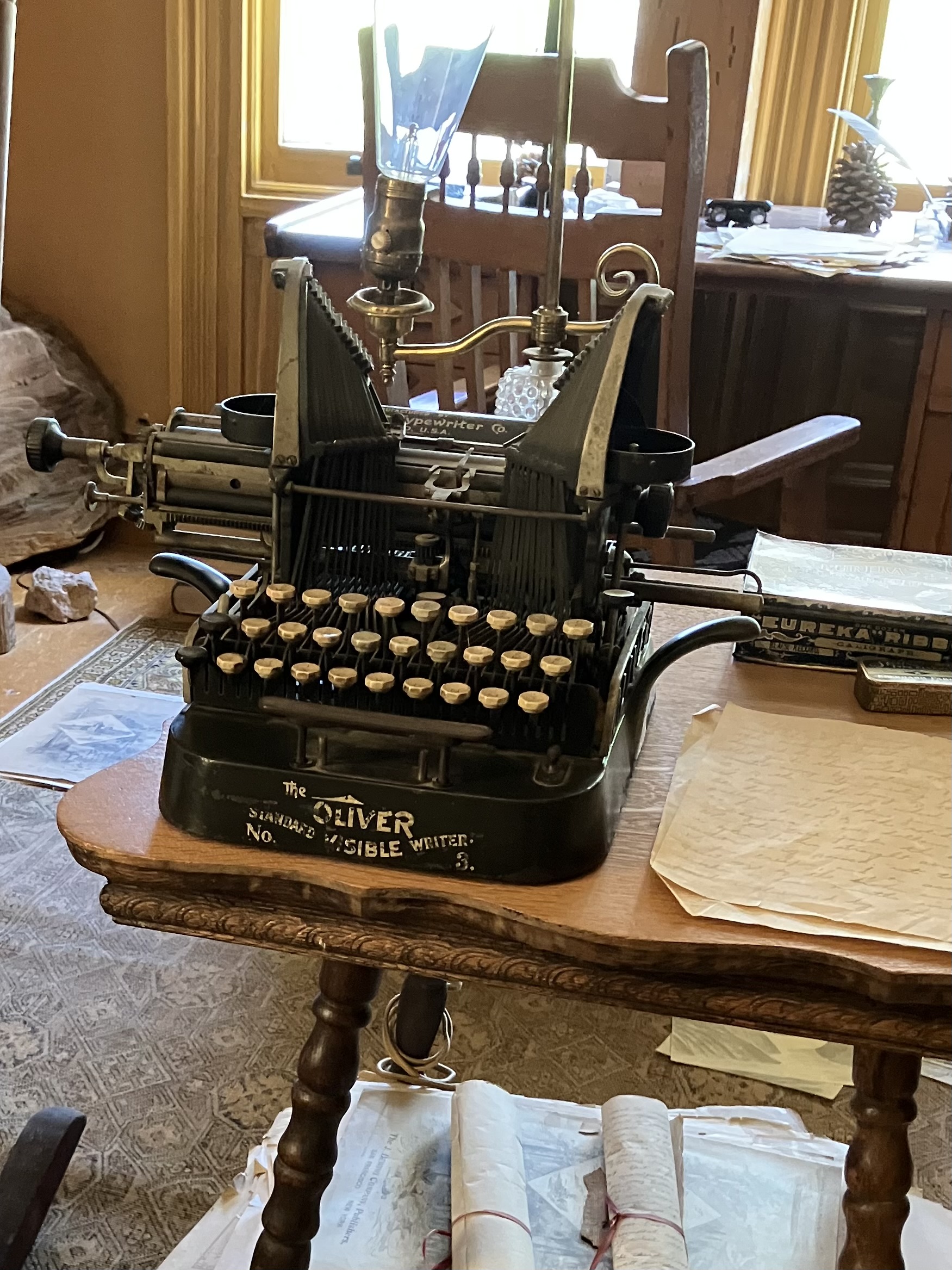
But for me the best was the “scribble den,” Muir’s office cluttered with piles of notes and pictures on the floor, lovely art of mountains on the walls, a microscope and pine cones on the desk beneath the big window with a lovely view. What touched me most was the tiny typewriter on which Muir wrote most of his books and articles. “This is where it all began,” I thought. The environmental movement, the massive efforts to preserve wilderness, the start of the national parks and Sierra Club—origins right here. Visitors should remove their shoes to stand on holy ground.

It turned out that the orchards begun by Muir’s father-in-law were lucrative enough to finance Muir’s writing and travel for the last 24 years of his life. He didn’t write with ease; in fact, he compared the process to the grinding of a glacier. But he loved his daughters, taught them about nature, and wrote them stories about the wilderness adventures of his dog-companion, Stickeen. He also took breaks from domesticity—his wife encouraged his trips to Alaska, Europe, Asia, South America and Africa. In the long arc of his life, the last chapter must’ve been a happy one.

Touching too, to see recipes hand-written by his daughters, for oatmeal cookies, coffee cake and cornbread. For 17 years, the family had a Chinese cook, the near-starvation of Muir’s earlier years finally assuaged. Muir never owned the land; it was passed on to his wife and daughters. Seems fitting for a man who objected to building a chapel in Yosemite; he maintained it was the cathedral.

Twists and turns in any life, but satisfying to see them so splendidly resolved in another person’s.

A Daring Transformation

Ka-BOOM! Sha-ZAM! Roofs raised, doors rattled, windows bulging, peace disrupted. Fun to write a cartoon version of Pentecost? Maybe not far from the original: the Spirit of Pentecost is sudden, wild, driving, fiery red, not soft pastels nor earth tones. Its music throbs, an insistent, direct pulse, no polite beating-around-the-bush: “Come Lord Jesus, send us your Spirit.” Now, when we need it, not “whenever it’s convenient” or “if You get around to it…”

This feast disrupts our glib assumptions, nudges beyond our complacencies, bursts through the locked doors of our self-imposed limits and defenses built since childhood. It bends what we once thought rigid, the boundaries of time and space. Jesus, who slips through the barriers fear erects, died several days ago. The astounded crowd outside (interesting, that none were the “in” group of disciples) hears in the speech bubbles their own first languages. No matter how many we learn later, the first is dearest, words of soothing lullabies, nursery rhymes, prayer. So, in chaos, the Spirit leads us home, to the first love, God’s, and the deep anchor, rest in our Creator. Even if we currently live in a place of pain, constraint, anger or frustration, it’s not our permanent residence.

Pentecost calls us to More—not as superheroes, but even better: as beloved children, each essential to one body, each with Spirit’s unique gift. Myriad languages, not all verbal, praise God. The Spirit understands if we speak in sports, dance, gardens, hospitality, humor, liturgy, art or healing. No swashbuckling achievements here: all is gift.  


Kathy Coffey, “A Daring Transformation,” from the May, 2025 issue of Give Us This Day giveusthisday.org (Collegeville, MN: Liturgical Press, 2025), Used with permission.

Feast of the Visitation—May 31

Sometimes women’s conversations can strike a spark. Or in this case, a conflagration. As scripture scholar Elizabeth Johnson points out, this meeting and outpouring occurs in Elizabeth’s home, traditional female domestic space. Zechariah, the only man around, is mute. “Such quieting of the male voice is highly unusual in scripture.” And in the hush, two pregnant prophets call out a message that will echo for generations.

Both Mary and Elizabeth lived under Roman oppression, but they knew that no matter how corrupt or cruel the state was, the last word is always God’s. God’s cherishing energy endures in a long line from their great-grandmothers to their great-great-grandchildren, us. God had been faithful to their people, who didn’t always deserve it, and God’s nature hadn’t changed. The brutality of the Roman Empire had conquered the known world, but their power would fade. Their soldiers would kill Mary’s son, but he would rise, offering hope and proof that violent bullies didn’t have the final say.

Human hope clings to our plans, but divine hope means immersion in God’s plan. Mary didn’t have a script in advance; didn’t know how her story would end. She simply did what we all must—walk one step at a time into mystery, trustfully.  

It would be natural for the women to complain—both are most inconveniently expecting—instead, they praise. In contrast to her husband’s confused questioning, Elizabeth, clearly attuned to her own blessing, can recognize the grace in Mary. Mary responds with a song of joy and social upheaval. The God of the Impossible will feed the starving, overturn the powerful, and remember the promise of mercy. Both women rejoice in this crazy kettle of fish—as should we.

Just as there are annunciations in every life, so too visitations: making a new friend, appreciating the long arc in the life of a friend from high school; discovering a new author or finding new insights on one we’ve always liked; meeting kindness in its many modes; savoring the fresh start of spring; welcoming a vista or activity never before experienced. The God of surprises hasn’t changed, and continues to flood us with the joy of the unexpected.

Easter 6—Kindly Reassurance

The context of Jesus’ farewell today is the last supper; the friends to whom he speaks are understandably confused and anxious. Earlier, they had questioned his allusions to leaving them. Temporarily? Or forever? He’d seen beneath Peter’s bravado (“Why can’t I follow you? I’ll lay down my life for you.”)

Under the arrogance, the needy, vulnerable child who desperately needs comfort. Jesus, not focused on his own imminent ordeal, looks fondly on his friends: bedraggled, flummoxed, sloppy, dear. And dreading more than anything, as most children do, being abandoned by those they love.

A similar situation is described by the marvelous poet and U. of Indiana professor Ross Gay in his book Inciting Joy, which traces the dance between sorrow and joy, the first state carving space for the second. His family, gathered around his dying father, leaves the hospital briefly for “a somber dinner…a pallor over us, edging toward the world without this person we loved.”

Like Jesus, his dad has been more focused on his loved ones than his own liver tumor. A week after the dad’s diagnosis, his son Ross gets sick. Dad cares for him, bringing a cold rag for his feverish neck, making lightly buttered toast, and when he feels up to eating more, a plate of supper he’s kept warm in the oven.

Ross doesn’t gloss over the fact that like most dads and teen-aged sons, they’d had a rough patch during his adolescence. But their relationship as adults shows how one can dwell in the other forever. They share a love for playing basketball, cooking, and smelling lilacs. “He would close his eyes to breathe [the fragrance] in, and I would do the same without noticing I do it, too.” Ross recognizes in himself the same bluster his dad shows when he’s “insecure, threatened, small, dumb, or not enough, which is not exactly infrequent.”

During their last goodbyes, Ross notices his father’s freckles, “like a gentle broadcast of carrot seeds… through my tears I saw my father was a garden… And from that what might grow.” Ross Gay’s community garden is a refuge from racism, and a deep source of joy, described in his Book of Delights. Another inheritance from his father, and a striking parallel to Jesus, who suffered and rose in a garden, bringing spring life. And how are we, maybe without even noticing, like him? From us, what might grow?

Easter 5—“Only a Little Longer”

Hang on for what may be a stretch—the imaginative connection between Jesus’ farewell to his friends, a selection of the gospel read in some churches this weekend, and schools all over the country drawing their years to a close. Both events are full of goodbyes and glories.

In the glory department, consider the first grade teacher who begins the year with three students at a kindergarten level. They have no pre-reading or writing skills as the other children do; they require a separate curriculum. Their teacher puts in many hours after school; volunteers work one-on-one with these children. Initially, they resist the nudge to work by creating games with pencils and erasers. Cheerful and apparently happy, they have little to no focus on the subject matter. When other children hunker down with a chrome book on their own, they look for chances to play.

Fast forward to May. Amazingly, these three are now slowly but surely reading. It feels like wheels are turning as they connect letters with sounds to say aloud. They can even sound out a word, approximate its spelling and form wobbly letters on a page.  Only a total cynic could say a miracle hasn’t occurred. Inch by inch, this trio has acquired the basics of skills that will get them not only through second grade and further education, but life.

Recently, I saw a Treasury of Dick and Jane, which must’ve been designed for Baby Boomers who learned to read with this little family. Father wore a coat and tie, Mother an apron and heels, and Baby Sally was endearingly round. The pastel illustrations and simple sentences brought back a rush of emotion: This was the beginning. For me, reading has enriched a lifetime, starting with children’s authors like Beverly Cleary and Katherine Paterson or series like Nancy Drew. It’s helped me endure boring stretches, long flights and disappointing days. Without it, life would be colorless and bleak. Fear of losing vision for reading keeps me eating spinach and popping eye vitamins.

On the back cover of my book, A Generous Lap: A Spirituality of Grandparenting there’s a photo of six grandchildren and meself, all of us wearing t-shirts that proclaim, “IdRather Be Reading.” Our stance applies to all the arts: I marvel when a choir director wrangles middle schoolers into memorizing lyrics, rehearsing, producing beautiful sound and performing their spring concert. Easily distracted and improbable vocalists, they concentrate on the leader, move in disciplined ranks, and master difficult harmonies.  

Praise to teachers, students and May, the season for grateful graduations, goodbyes, beginnings—all giving glory to God.

Easter 4—Good Shepherd

Jesus as Good Shepherd may seem a difficult concept for readers whose experience is primarily urban. But the more I think about it, the richer it seems. Never mind that shepherds say the critters they tend are stupid and smelly. No odd aromas nor slow wits deter Jesus. He simply says, “I know my own,” placing no blame.

On Easter Monday, the gospel mentions the women running from the tomb with a cocktail of emotions, “fearful yet overjoyed.” “And behold, Jesus met them on their way and greeted them” (Mt. 28: 9). No matter how meandering our ways, through grocery stores or gyms, offices or schools, retirement centers or prisons, Jesus, eager to see us, meets us on each unique and personal path. We needn’t be running a marathon or ascending to an altar—he’s there waiting, arms open wide.

Few of us look out our windows to see shepherds with flocks on the hillsides, but if we broaden the imagination, we can see them in unique ways. People shepherd creatively, perhaps never dreaming that they model one who gathers the sheep in his arms. For example,

A mom with a demanding job and two young children nevertheless stays at the vet with her sick dog overnight and throughout another day. She can’t bear to leave him, frightened and alone, so she sacrifices her sleep. Just what the Good Shepherd might do…

In Oakland, CA, over 100 volunteers read in 14 elementary schools to 5,000 students for Asian-American and African-American months, shepherding children from a variety of backgrounds towards, or re-acquainting them with, fascinating cultures.

Dean William Treanor of Georgetown Law shepherded his school when the Trump administration threatened to bar their students from federal jobs if diversity, equity, and inclusion continued to be part of the curriculum. With a clear, succinct “No,” he said, “that is not who we are.” Uncowed by bullying, Treanor wrote: “The First Amendment… guarantees that the government cannot direct what Georgetown and its faculty teach and how to teach it.” As a Jesuit and Catholic institution, they have always welcomed people from diverse backgrounds and perspectives—and will continue to do so.

A guard at the Louvre museum in Paris noticed a small girl crying. She’d been pushed out of the crowds so eager to take a selfie with the Mona Lisa, they’d shoved her aside. Afraid she was lost, the guard found her grandmother and led them to a clear space in front of the art, took their pictures and stopped the tears. Of course he didn’t have to do it, but the shepherding instinct runs deep and kind.

As it does for a man who explains somewhat shyly that he’s kept his housekeeper when he no longer needs one. “But she’s 65—and where would she go?” he asks from a large and generous heart.

A religious sister who works in prisons introduces “Project Bedtime Story,” where inmates read to their children, their voices then electronically conveyed home to the kids. Both men and women’s prisoners even add back up choruses, singing the ABC song or whatever works as their friends read aloud.

So the Shepherd strolls, maybe where we least expect…

Third Sunday of Easter—“Breakfast!”

The skunking of the tired disciples in John 21:1-19 reminds me of Sandra Cisneros’ comparison of fishing to writing. The author of The House on Mango St. and many other works celebrating her Mexican heritage said the writing process is like assembling your gear, your tackle, your bait and your boat. Then after all that preliminary work, you row out, cast your line into the water and wait for a tug. A fish? Or for a writer, an inspiration, the words on the page falling together with a pleasing cadence, the ideas or the characters aligning surprisingly well.

How must they have felt, then? Jesus’ friends, after a discouraging night, suddenly find a net so full they can barely pull it in. Then, they don’t even need to arrange a celebration—Jesus has it all prepared. The maternal Jesus—a man who cooks–invites his tired, bedraggled disciples, “come, children, have breakfast.” He’s waited till dawn on the shore for them, now speaks to the hungry and bewildered a word of comfort, offering exactly what they need.

No fulmination, no revenge, no recrimination. Just a silhouette against the sunrise, and the tenderness of a parent feeding a family. The scene is so close to home, it affirms and underlines all we know best: goodbyes past, the warmth of fire, beauty of water, relief of food when we’re really hungry. Before asking Peter to feed the flock, Jesus makes sure his friend is well fed himself. He knows how wavering and uncertain our human nature can be. But he also knows, like a good mom, how to nurture.

Theologian Karl Rahner, SJ says “the resurrection means we become all we could ever have been. All the limits of this life are lifted and we are all we could ever hope and desire to be.” What potential! My imagination runs amuck with this—becoming a fine poet, a marine biologist, a really good wife and mother, a ballerina, an activist for justice, a world-renowned artist or musician, an environmentalist, a doctor-without-borders, an Olympic gymnast/skater/swimmer.

Even naming these must mean the seeds are in us, which will someday flower. So our own resurrections mean not only entering into infinite love, but also achieving all the goals we didn’t even attempt on earth. If limits on time and space are off, we can return to our favorite, most beautiful places in this world—with no check-out time.