Category Archives: Family Spirituality

Book Review: An Altar in the World

Barbara Brown Taylor has long been such a favorite author that I often drool with envy, wishing I had written exactly what she just said. This Episcopal priest is in touch with scripture, liturgy and the hard work of a four-day power outage, when she breaks the water in the horses’ trough with a hammer twice a day. The focus here will be on one of her books, but all are a delight.

An Altar in the World begins in wonder “about what happens when we build a house for God…What happens to the rest of the world when we build four walls—even four gorgeous walls—cap them with a steepled roof, and designate that the House of God? What happens to the riverbanks, the mountaintops, the deserts, and the trees? What happens to the people who never show up in our houses of God?”

For an example of her broad vision, she cites St. Francis of Assisi who “read the world as reverently as he read the Bible.” (p. 9) She then piles on abundant evidence to help us pay attention to God in the world: through our own bodies, through saying no, through physical labor, and pain “which leads to the ground floor of all real things: real love, real sorrow, real thanks, real fear,” an altar to discover “life as full of meaning as it is of hurt.” (173)

Her description of discovering her vocation is delightful for its earthiness. She repeatedly climbs a fire escape wobbling from a Victorian mansion next door to the Divinity School. There in her prayer spot, she asks God what to do with her life, receiving the answer, “anything that pleases you.” Hence, she had a career that included cocktail waitressing, newspaper reporting, teaching horseback riding, preaching and pastoring—with one tantalizing possibility still hovering on the horizon: being a member of Cirque de Soleil.

Not the least bit churchy, irreverent, open-minded, quick to admit flaws, a superb writer who’s a stickler for the precise word, Taylor would make a marvelous companion for brunch. Or travel. Or anywhere else she might wander, with her conviction that “life is unmitigated gift.” She brings spirituality a much missing dimension: humor. Sometimes, she even prompts a delicious chuckle aloud. She questions the sacrosanct and tweaks the easy assumption, getting by with it in her creamy Georgia accent. (Podcasts also abound.) Her grounded priorities help us lose our appetite for social media gossip and shopping bargains. I will try to carry and continue her practice of “saying thank you now, while I still approve of most of what is happening to me, [so] then that practice will have become habit by the time I do not like much of anything that is happening to me.” Sound advice for aging!

The Feast of the Sacred Heart—June 16

Even after more than 50 years since my education by the Religious of the Sacred Heart, this feast still captures attention, still intrigues by its contradictions. On the negative side, the fierce discipline, the school’s obsession with rules, silence and order might have been simply the products of an era when few schools were enlightened or relaxed. Some friends have worse horror tales from crazier nuns and more uptight Catholic schools.

On the positive side, I still remember a statue of Jesus as the Sacred Heart which stood outside our school. It had the odd heart-outside-the-body typical of sentimental art. But more important: his arms were flung wide in welcome. His hands didn’t hurl thunderbolts, tick off lists of wrongdoing, or brandish law books.

The stance epitomized the insight of St. Margaret Mary Alacoque, credited with popularizing devotion to the Sacred Heart. “The divine heart…is an ocean full of joy to drown all our sadness…” When she tried to convince others of this broadly inclusive approach, authorities called her delusional. Indeed, she had made a huge stride forward from 17th century piety, with its emphasis on the externals of religion.

The inclusive tone of today’s feast is consistent with Julian of Norwich’s writing in The Showings about God as mother. “In the sight of God, we do not fall” (p. 222) because we are always graciously enfolded in love. Just as a mother brims with pride in her child, so we too are God’s joy, treasure and delight (p. 228). I’ve written about Julian in other places; thanks to a Sacred Heart education for the assurance that God can’t not love.

Movie Review—”Wild Life”

Intriguing how heroes in every era emerge to meet the particular needs of the time: Harriet Tubman and Wilbur Wilberforce to combat slavery, Susan B. Anthony to secure women’s vote or M.L. King to press for black civil rights, Rachel Carson to speak for the environment. The list could go on, but extraordinary people seem to arise in sync with the specific demands of the situation and a company of anonymous others: artists, scientists, political activists, theologians, writers, musicians and engineers.

For our times, when the destruction of the planet seems imminent, Kris and Doug Tompkins worked for 30 years to preserve wilderness and protect biodiversity. Their story is told in “Wild Life,” a National Geographic film which will appear on their t.v. channel June 16, is streaming on Hulu and Disney+ and showing in a few theaters.

At first it seems unlikely that a newlywed, middle-aged couple who had amassed a fortune through North Face, Esprit, and Patagonia clothing lines wouldn’t want to luxuriate in the beach homes, yachts, cars, penthouses, designer jewels and clothing that seem to appeal to many millionaires. Instead, they created Tomkins Conservation which bought and “protected approximately 14.8 million acres of parklands in Chile and Argentina through the creation or expansion of 15 national parks in those countries, in addition to two marine protected areas of 30 million acres.”

Their initial efforts met with criticism and resistance from the Chilean government. Many people were skeptical of multi-millionaire Doug’s efforts to buy huge swathes of their country: what was his ulterior motive?  Chile had a mining-based economy—why not simply continue reaping its profits? Furthermore, the US had supported the oppressive Pinochet regime: was this prelude to another dictator? As a Chilean senator who was once an ardent foe admits later, “we treated them very badly. 98% of people would’ve just gone home.”

Knowing the insurmountable odds the Tompkins faced makes their largest private land donation in history even more spectacular. Add in the stupendous scenery of Patagonia, and the viewer can’t help root for their efforts. A terrible tragedy finally becomes the turning point: when Doug is killed in a kayaking disaster and buried in Chile, native people start appreciating the gift. Kris’ efforts to carry on the work despite her heartbreak come to a dramatic climax at a ceremony where deeds for the parks are signed and she embraces Michelle Bachelet, Chilean president. Almost as if two women have finally pulled it off!

The nonprofit organization Kris and Doug cofounded, Tompkins Conservation continues to bring back endangered species through rewilding, and to help communities thrive through nature-based tourism. Patagonia outdoor clothing line, founded by Yvon Chouinard, Doug’s best friend, works hard to ensure the sustainability of their products and donate some of their profits to preserving wilderness. The documentary offers extensive interviews and footage of these guys who began as skiing, climbing and surfing buddies, had a tremendous knack for business, yet manage to preserve a certain flannel-shirt naturalness. Kris Tomkins herself is luminous; she recorded long, rigorous, often frustrating efforts in her diary and she shines when climbing a peak Doug named for her, symbol of a larger success. The film has a pervasive tone of joy, filled with exhilaration that some people really are trying to save our beautiful, threatened blue-green planet.

Best and Worst of Catholic

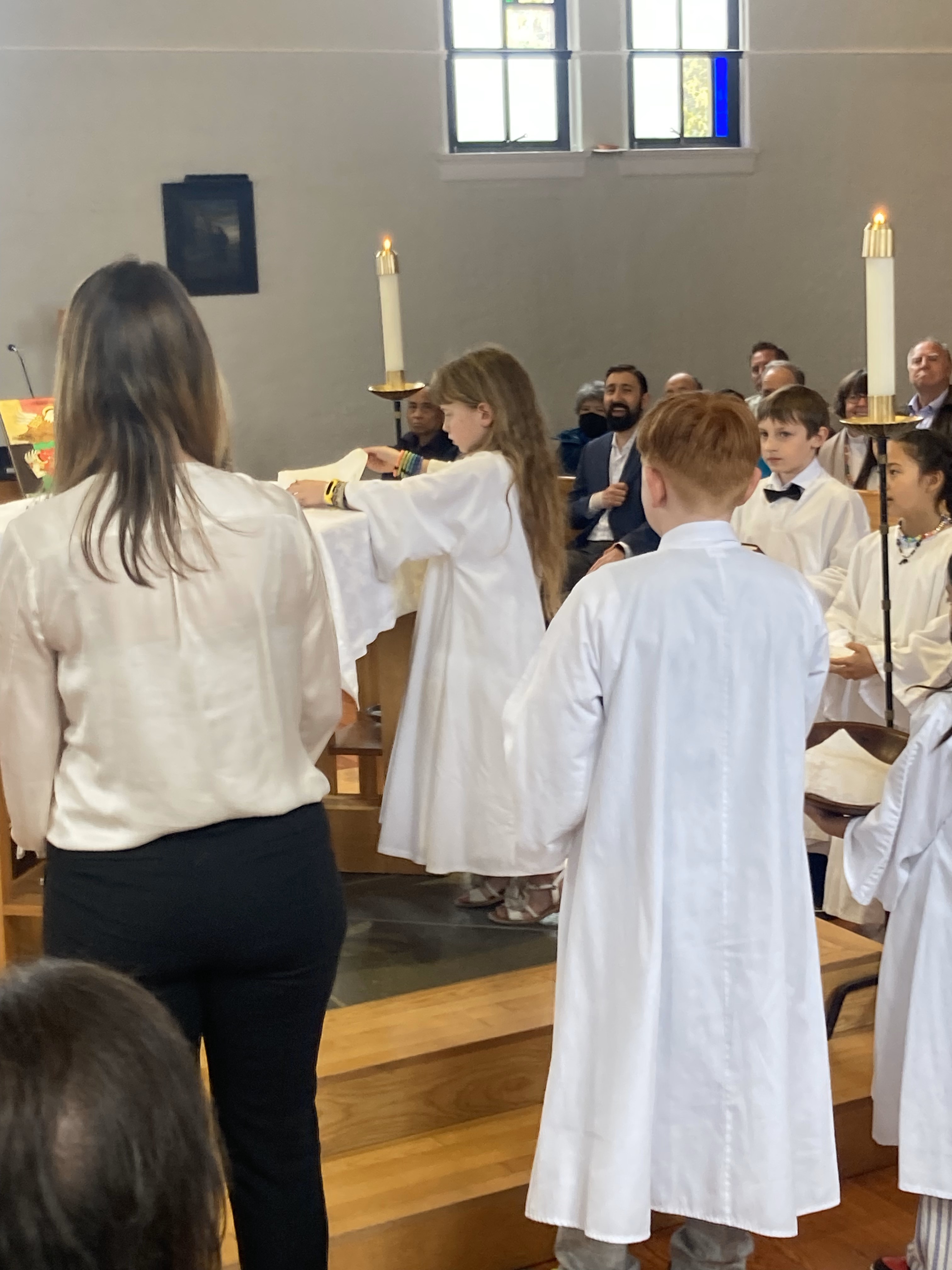
The gospel choir began with a bang and kept the energy high during this celebration of First Eucharist at St. Therese parish in Seattle. A tiny girl, younger sibling of one of the seven children receiving Eucharist for the first time, carried the cross high, leading the entrance procession. Parents bounced babies, everyone clapped more or less together, and the choir poured their hearts out. I was there for my granddaughters, and as the Mass went on, thought, “This is the best of Catholic.”

A group of many ages and diverse ethnicities, our focus was on the children. All wore simple, identical white albs, so none of the emphasis on clothing that had shadowed too many of these celebrations. To them we were entrusting one of our finest treasures, and they had been well prepared. The day before, they learned to handle the chalice reverently and not make funny faces for their first sip of wine. They decorated a candle and lit it from the Paschal candle, then their parents told the children how they brought the light of Christ into their homes.

It reminded me of the day before my own First Communion, over 60 years ago. Still, I hold one vivid memory. Skipping with anticipation, I was walking across the playground with the sister who had prepared us. “Are you excited?” she asked. “Of course!” “And God is just as excited,” she happily replied.

That tone of joy welcomed my granddaughters and their group. Each child played a part, one carefully placing and smoothing the altar cloth, another bringing wine, a third pouring water. The preparation was similar to ways they’d probably set the table at home, but this time was special. Jesus was host and hostess, inviting and delighting, calling the littlest to himself, as he had always done. He would’ve liked the relaxed attitude here—no pressure on the children about not goofing up, so of course they didn’t. The pastor even included Mrs. Cleopas in his homily on Emmaus, so extra points to him!

The contrast when I visited St. Peter’s Basilica in Rome two weeks later was staggering. There, I felt the power and majesty, but little of the joy. Yes, the Vatican is a repository of world art, and kudos to them for that. But the focus is on order, control, male dominance (endless statues and plaques of popes). The only thing that comes close to mirroring the poor carpenter who began it all is the Pieta, but even there, crowds block views and there is no bench where one might sit and reflect.

Little here to make the heart soar; I thought longingly of Celtic spirituality which de-emphasizes the role of church and instead looks to God’s shining throughout creation. Probably a personal preference and maybe a quirk of character, but guess where I felt closer to God—St. Therese’s or St. Peter’s?

Pentecost

One of the most striking sentences in the first reading from Acts (2:4) describes people speaking different languages, yet still being understood. We all know that even those who speak the same language can have a hard time communicating. Pentecost reverses the Tower of Babel story, which tries to explain why people began speaking in different languages. The people that day achieved understanding, despite their linguistic differences.

Pentecost continues today, as African students in an ESL classroom learn English and across the hall, North Americans learn Spanish. Movies streamed into our homes educate us on the cultures of Iran or Korea.  Small Californians learn to eat dumplings with “cheater” chopsticks.

One way to celebrate Pentecost is to appreciate the Holy Spirit’s ongoing work in our lives. The processes of ordinary living are so fragile, so immensely significant, so fraught with terror, that we desperately need someone beyond ourselves. We need the warmth and power of the Spirit to help us in whatever we have undertaken.

With whoosh of wind, the Spirit barrels through the US in the Pentecost I imagine. Just as faith leaders of all traditions once joined to march with M. L. King Jr. and enact Civil Rights legislation, so Muslims, Jews, Christians, atheists and agnostics rise together as a concerted public voice for gun safety. They move past “thoughts and prayers” to concrete legislation to reduce the skyrocketing death toll. They don’t want their country to be known as the nation where guns are the #1 cause of death for children.

Hopefully, we’ll look back on these efforts and say, “So you, life-giving Spirit and Guide, were there all along.” A phrase later in Acts describes a Spirit-guided way of making decisions: “For it has seemed good to the Holy Spirit and to us” (Acts 15:28). That might sound arrogant, or even cynical (If this backfires, we can always blame the Spirit). So too, we make decisions with the Holy Spirit, maybe not naming that presence or guessing that strength. But in the long run, what hope, power and grace!

Easter 7—Women as Afterthought

It’s such a toss-away line, it deserves response. This weekend’s reading from Acts names each male disciple individually and precisely, then clumps “together with some women, and Mary the mother of Jesus…” the anonymous female crowd. Hmmmm…let’s hear their side of the story.

“Christ risen from his sepulcher at last,

Appeared to women first

So that the news would travel very fast. “ (Filippo Pananti, “Epigram VII”)

Or as Pope Francis said, “the Apostles and disciples find it harder to believe in the Risen Christ… Not the women, however!” One of them, Salome (they did have the dignity of names), remembers finding the sweet spices, unused:

I found the jar in the

shadows of a shelf, years later. Inching

open the dusty lid, fragrance brought it all back:

the fear-filled morning, milky before

dawn, exhausted friends’

faces, red-eyed with

crying and no sleep.

“Let’s do what we can”

our inglorious resolve.

I’m still embarrassed

that we ran terrified from

one who told us not to fear.

Were we fleeing something

in ourselves, that I know now

resurrects? Was the news

too good to believe?

I swirl these tiny spice grains

like puzzle pieces, wondering:

the fact we never used them,

their scent now slightly stale,

does it prove something stupendous?

Excerpt from More Hidden Women of the Gospels by Kathy Coffey, Orbis Press, Orbis Books, orbisbooks.com, 800-258-5838

Easter 6—Kind Reassurance

“I will not leave you orphans; I will come to you.”

The context of Jesus’ promise is the last supper; the friends to whom he speaks are understandably confused and anxious. Earlier, they had questioned his allusions to leaving them. Temporarily? Or forever? He’d seen beneath Peter’s bravado (“Why can’t I follow you? I’ll lay down my life for you.”)

Under the arrogance, the needy, vulnerable child who desperately needs comfort. Jesus, not focused on his own imminent ordeal, looks fondly on his friends: bedraggled, flummoxed, sloppy, dear. And dreading more than anything, as most children do, being abandoned by those they love.

A similar situation is described by the marvelous poet Ross Gay in his 2022 book Inciting Joy, which traces the dance between sorrow and joy, the first carving space for the second. His family, gathered around his dying father, leaves the hospital briefly for “a somber dinner…a pallor over us, edging toward the world without this person we loved.”

Like Jesus, his dad has been more focused on his loved ones than his liver tumor. A week after his own diagnosis, his son Ross gets sick. Dad cares for him, bringing a cold rag for his feverish neck, making lightly buttered toast, and when he feels up to eating more, a plate of supper he’s kept warm in the oven.

Ross doesn’t gloss over the fact that like most dads and teen-aged sons, they’d had a rough patch during his adolescence. But their relationship as adults shows “because I live, you also will live.” They share a love for playing basketball, cooking, and smelling lilacs. “He would close his eyes to breathe [the fragrance] in, and I would do the same without noticing I do it, too.” Ross recognizes in himself the same bluster his dad shows when he’s “insecure, threatened, small, dumb, or not enough, which is not exactly infrequent.”

During their last goodbyes, Ross notices his father’s freckles, “like a gentle broadcast of carrot seeds… through my tears I saw my father was a garden… And from that what might grow.” A striking parallel to Jesus, who rises in a garden, bringing spring life. And how are we, maybe without even noticing, like him?

Easter 5–A Roomy Home

In today’s gospel, Jesus leads his listeners from a visible, tangible reality to the spiritual world it represents. When he speaks of his Father’s house, we may think of our own homes—places which may need repair and cleaning, but where we are our most authentic selves. At home we drop the masks; there we laugh, cry and love freely. We are as intimate with God as with those who live in the same house.

Jesus’ promise that God’s house has many rooms reassures those who worry whether they’d fit into the celestial palaces often portrayed in art. We’re too earthy or grimy to hobnob with angels on golden floors. “Ah no,” smiles Jesus. “If your idea of heaven is a mountain cabin beside a flowing trout stream, that’s what I’ve prepared. So too for those who want the English Tudor in the rolling hills, or the beach cabana.”

It’s a feast for the imagination and a comfort to those whose loved ones have died. How sweet to think of them happy in the home they’ve always wanted, carefully prepared by their Creator. Jesus’ promise stems from the marriage custom of his day. After the betrothal, a young man left to build a room onto his parents’ extended family dwelling for himself and his bride. Before he left, he told her, “I go to prepare a place for you, that where I am you may be too.” Imagine Jesus speaking these wondrous words to us. 

Easter 4—Good Shepherd

Jesus as Good Shepherd may seem a difficult concept for readers whose experience is primarily urban. But the more I think about it, the richer it seems. Never mind that shepherds say the critters they tend are stupid and smelly. No odd aromas nor slow wits deter Jesus. He simply says, “I know my own,” placing no blame.

On Easter Monday, the gospel mentions the women running from the tomb with a cocktail of emotions, “fearful yet overjoyed.” “And behold, Jesus met them on their way and greeted them” (Mt. 28: 9). No matter how meandering our ways, through grocery stores or gyms, offices or schools, retirement centers or prisons, Jesus, eager to see us, meets us on each unique and personal path. We needn’t be running a marathon or ascending to an altar—he’s there waiting, arms open wide.

I recently observed Catechesis of the Good Shepherd, where Emmy, aged seven, her glossy dark hair escaping from the braids where it had probably been neatly placed earlier in the day, was asked what the Shepherd does. One strap of her overalls was unfastened, but she was clear in her response. Softly, she said, “He takes care of us.” All we need to know for security and confidence…

In a relevant tangent: The shrine of Our Lady of Aranzazu, Spain was built on the site where Rodrigo de Balzategui, a Basque shepherd, found a statue of the Virgin Mary nestled in a thorny bush with a cowbell in 1469. Stunned, he asked, “You? Among the thorns?” Exactly where a shepherd might seek the lost, in brambly wild places. St. Ignatius visited the shrine in 1522 on his way to Montserrat. Some suspect the experience must have influenced his signature quest for “finding God in all things.”

Third Sunday of Easter—Emmaus

Jesus’ disclosure of himself in Luke’s gospel to those who are “on the road’ comes as good news to people who are often in motion. While some may criticize the frenzied mobility of our era, Jesus joins the journey.

I like to think of Cleopas’ unnamed companion as Mrs. Cleopas, since if the person had been male, he would’ve been named. In a parish where I suggested this possibility during a retreat, the following year the lay homilist had his wife join him for a dialogue about their journey—perhaps edging closer to the original?

There are striking parallels between Jesus’ actions and contemporary thought on how to help people overwhelmed by tragedy or stuck in trauma. In Images of Hope, William Lynch, SJ  suggests that the imagination proposes “boundaries of the possible [that] are wider than they seem.” Luke records that the two companions stopped short, immobilized by sorrow. When Jesus invites them to talk about the Crucifixion, he places the events in the context of a larger story. He “frees the imagination to fight its way out of the dreary cage of the instant.” As they begin to answer his question, they resume their walk. Furthermore, they journey into recognition and elation.

It’s especially appealing that they recognize Jesus not in formal worship or a church setting, but at the kitchen table, breaking bread. Christian ritual began in a home, growing from a long Jewish tradition of domestic prayer. Jesus thus affirms that the household is holy ground. Furthermore, he demonstrates that our most ordinary routines can be sacramental, that we can move beyond despair, that our times and spaces are sacred.

Excerpt from Hidden Women of the Gospels by Kathy Coffey, Orbis Press, orbisbooks.com, 800-258-5838.