
“And I was beside [God] as a craftsman, and I was [God’s] delight day by day, playing on the surface of [God’s] earth…”
On a particularly gorgeous stretch of God’s earth called Yosemite, John Muir played with delight. His quotes about nature fill many books, but just one is illustrative: “No pain here, no dull empty hours, no fear of past… or future. These blessed mountains are so filled with God’s beauty, no petty personal hope or experience has room to be.” Swinging high in a tree to fully experience a storm, building a cabin at the foot of a waterfall, hiking for miles—Muir burrowed deep into his experience of wilderness and thrived. He warned others about the threat of industrialization, valuing “nature’s peace which will flow into you as sunshine into trees.”
So I was somewhat puzzled by the time in his life biographers call the “domestic chapter,” when Muir, who married at age 42, settled with his wife and two daughters into a farmhouse in Martinez, California. An “Italianate Victorian home” with 17 rooms including a “formal parlor” seems an odd setting for a mountain man. Furthermore, this impressive mansion had indoor plumbing, gas lighting, and a phone installed as early as 1885. All the modern conveniences for a man who survived for many years on hard crusts of bread?
Then I visited the home, now maintained by the National Park Service. It was heartening to see the huge fireplace for roaring logs Muir installed after the 1906 earthquake, the balcony where he’d sometimes pitch a tent, probably still longing to sleep beneath the stars, and the bell in the cupola, used to call the family home from work in the surrounding orchards or hikes on Mt. Wanda, named for the oldest daughter. (She said “Father was the biggest, jolliest child” on these adventures.) The ranch of over 2,600 acres in the Alhambra Valley must’ve been especially beautiful when the fruit trees were in bloom.
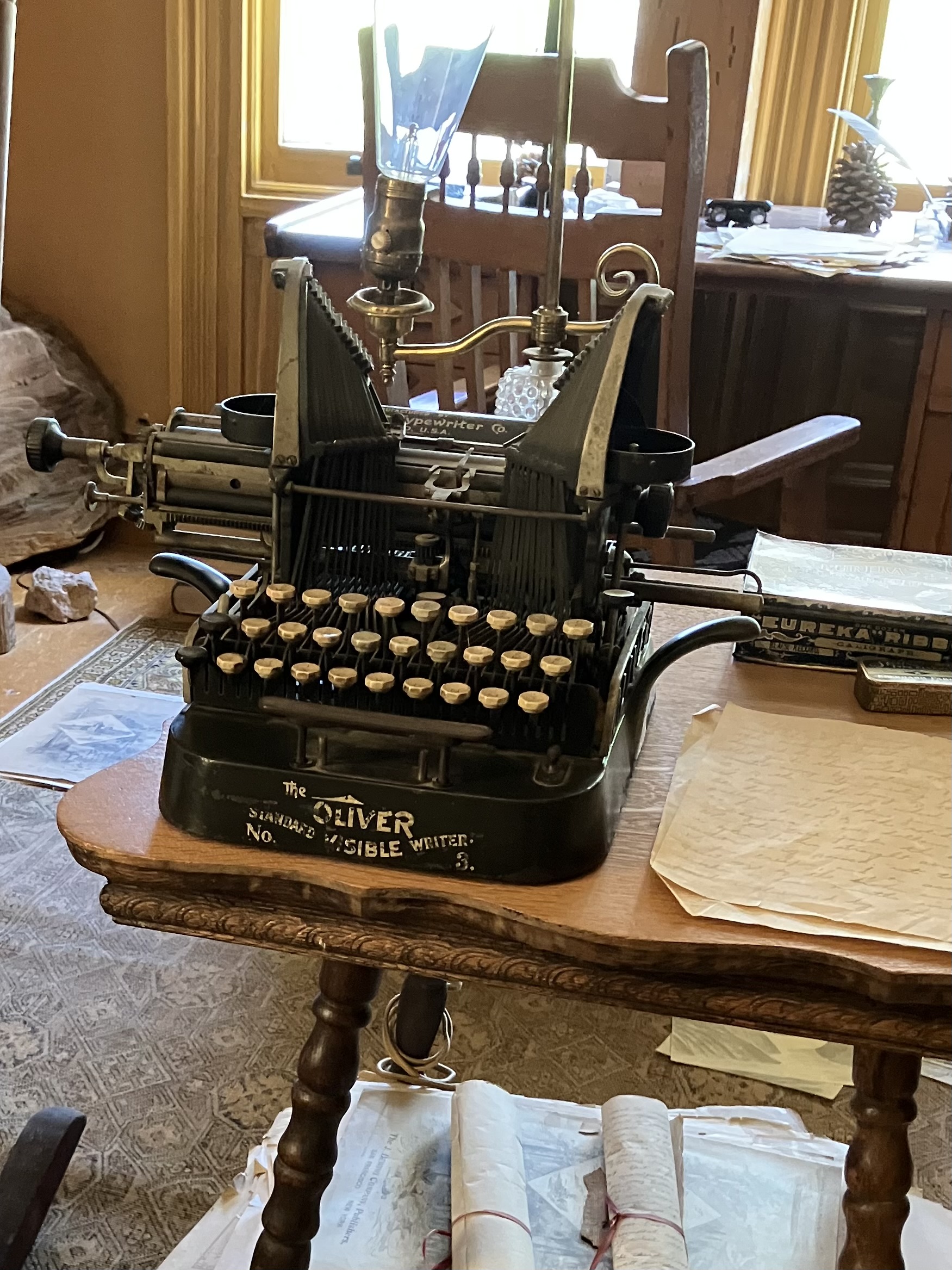
But for me the best was the “scribble den,” Muir’s office cluttered with piles of notes and pictures on the floor, lovely art of mountains on the walls, a microscope and pine cones on the desk beneath the big window with a lovely view. What touched me most was the tiny typewriter on which Muir wrote most of his books and articles. “This is where it all began,” I thought. The environmental movement, the massive efforts to preserve wilderness, the start of the national parks and Sierra Club—origins right here. Visitors should remove their shoes to stand on holy ground.
It turned out that the orchards begun by Muir’s father-in-law were lucrative enough to finance Muir’s writing and travel for the last 24 years of his life. He didn’t write with ease; in fact, he compared the process to the grinding of a glacier. But he loved his daughters, taught them about nature, and wrote them stories about the wilderness adventures of his dog-companion, Stickeen. He also took breaks from domesticity—his wife encouraged his trips to Alaska, Europe, Asia, South America and Africa. In the long arc of his life, the last chapter must’ve been a happy one.
Touching too, to see recipes hand-written by his daughters, for oatmeal cookies, coffee cake and cornbread. For 17 years, the family had a Chinese cook, the near-starvation of Muir’s earlier years finally assuaged. Muir never owned the land; it was passed on to his wife and daughters. Seems fitting for a man who objected to building a chapel in Yosemite; he maintained it was the cathedral.
Twists and turns in any life, but satisfying to see them so splendidly resolved in another person’s.

 Kathy Coffey